>
Blenniiformes (Blennies) >
Blenniidae (Combtooth blennies) > Salariinae
Etymology: Blenniella: Diminutive of blennius, Greek,blenios = mucus (Ref. 45335).
More on author: Bleeker.
Taxonomic Remarks
Genus Williams, pers. comm.
Milieu: milieu / Klimaatzone / Diepte / verspreidingsgebied
Ecologie
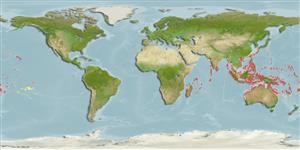
marien rifbewoner; diepte 0 - 6 m (Ref. 1602). Tropical; 32°N - 30°S, 37°E - 129°W
Indo-Pacific: east coast of Africa to the Society Islands, north to the Ryukyu Islands, south to about 24°S.
Grootte / Gewicht / Leeftijd
Maturiteit: Lm ? range ? - ? cm
Max length : 13.0 cm SL mannelijk / geslacht onbekend; (Ref. 9710)
Korte beschrijving
Determinatiesleutels | Morfologie | Morfometrie
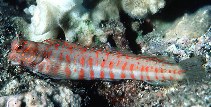
Dorsale stekels (totaal) : 12; Dorsale zachte stralen (totaal) : 20 - 21; Anale stekels: 2; Anale zachte stralen: 21 - 22. Distinctive coloration of the head (Ref. 48636).
Body shape (shape guide): elongated.
Adults inhabit clear coastal reef flats, often in exposed habitats, common in outer intertidal reef flats and surge-swept seaward reef; usually where algal growth is prolific (Ref. 48636). They enter small holes, with just its head protruding. They feed on algae and associated detritus and small invertebrates. Oviparous. Eggs are demersal and adhesive (Ref. 205), and are attached to the substrate via a filamentous, adhesive pad or pedestal (Ref. 94114). Larvae are planktonic, often found in shallow, coastal waters (Ref. 94114). Minimum depth of 0 m reported from Ref. 90102.
Levenscyclus en paargedrag
Maturiteit | Voortplanting | Paaien | Eieren | Fecunditeit | Larven
Distinct pairing (Ref. 205).
Springer, V.G. and J.T. Williams, 1994. The Indo-West Pacific blenniid fish genus Istiblennius reappraised: a revision of Istiblennius, Blenniella, and Paralticus, new genus. Smithson. Contrib. Zool. 565:1-193. (Ref. 9962)
Status op de Rode Lijst van het IUCN (Ref. 130435: Version 2025-2 (Global))
Gevaar voor de mens
Harmless
Gebruik door de mens
Visserij: van geen belang; Aquarium: Commercieel
Tools
Speciale rapporten
Download XML
Internetbronnen
Schattingen op basis van modellen
Gewenste temperatuur (Ref.
123201): 25.4 - 29.3, mean 28.5 °C (based on 2491 cells).
Fylogenetische diversiteitsindex (Ref.
82804): PD
50 = 0.5020 [Uniqueness, from 0.5 = low to 2.0 = high].
Bayesian length-weight: a=0.00776 (0.00354 - 0.01702), b=3.00 (2.81 - 3.19), in cm total length, based on LWR estimates for this (Sub)family-body shape (Ref.
93245).
Trofisch niveau (Ref.
69278): 2.5 ±0.19 se; based on food items.
Weerstandsvermogen (Ref.
120179): Hoog, minimale populatieverdubbelingstijd minder dan 15 maanden (Preliminary K or Fecundity.).
Kwetsbaarheid van de visserij (Ref.
59153): Low vulnerability (10 of 100).
🛈
Voedingsstoffen (Ref.
124155): Calcium = 129 [63, 209] mg/100g; Iron = 0.731 [0.420, 1.245] mg/100g; Protein = 18.1 [16.9, 19.2] %; Omega3 = 0.0767 [, ] g/100g; Selenium = 19.1 [9.3, 41.6] μg/100g; VitaminA = 127 [35, 464] μg/100g; Zinc = 2.21 [1.47, 3.17] mg/100g (wet weight);