>
Eupercaria/misc (Various families in series Eupercaria) >
Labridae (Wrasses) > Xyrichtyinae
Etymology: Iniistius: Latin, in = in + Greek, istion = sail.
More on author: Valenciennes.
Περιβάλλον: περιβάλλον / κλιματική ζώνη / εύρος βάθους / εύρος διανομής
Οικολογία
Θαλασσινό(ά) Υφαλόφιλο(α); εύρος βάθους 1 - 100 m (Ref. 1602), usually 20 - ? m (Ref. 9710). Tropical; 24°C - 28°C (Ref. 27115); 30°N - 30°S
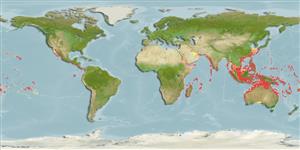
Indo-Pacific: Red Sea and East Africa to the Society Islands, north to southern Japan and Hawaii, south to the Lord Howe Island. Eastern Pacific: Gulf of California to Panama and the Galapagos Islands (Ref. 5227).
Μέγεθος / Βάρος / Ηλικία
Γεννητική Ωρίμανση: Lm ? range ? - ? cm
Max length : 42.0 cm TL αρσενικό/απροσδιόριστο; (Ref. 97145)
Σύντομη περιγραφή
Κλείδες προσδιορισμού | Μορφολογία | Μορφομετρία
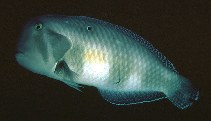
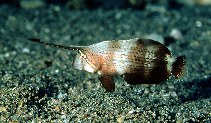
Ραχιαίες άκανθες (συνολικά) : 9; Μαλακές ραχιαίες ακτίνες (συνολικά) : 12 - 13; Εδρικές άκανθες: 3; Μαλακές εδρικές ακτίνες: 12 - 13. Identified by the dark vertical bar below the eye. Usually with 5 dark bars when adult and belly of female turns red. Juveniles with black anal fin and two large ocelli, thinly edged with white, in dorsal fin (Ref. 48636). First two dorsal spines form a separate fin. Juveniles this fin forms a long, bannerlike filament but shortens with age (Ref. 37816).
Body shape (shape guide): fusiform / normal; Cross section: compressed.
Usually solitary in lagoon and seaward reef areas with fine to loose, coarse sand bottoms (Ref. 1602). Juveniles sometimes in shallow estuaries (Ref. 48636). Adults rare in less than 20 m (Ref. 9710). Benthic and benthopelagic (Ref. 58302). Dives into sand to sleep safely at night or to hide when alarmed (Ref. 9311, 90102). Feed on hard-shelled invertebrates, including mollusks and crustaceans (Ref. 9311). Juveniles mimic drifting dead leaves by holding the elongate detached front part of dorsal fin forward over head. Good to eat, flesh very white (Ref. 7364). Minimum depth reported from Ref. 27115.
Κύκλος ζωής και συμπεριφορά ζευγαρώματος
Γεννητική Ωρίμανση | Αναπαραγωγή | Γεννοβολία | Αβγά | Γονιμότητα | Προνύμφες
Distinct pairing during breeding (Ref. 205).
Randall, J.E., G.R. Allen and R.C. Steene, 1990. Fishes of the Great Barrier Reef and Coral Sea. University of Hawaii Press, Honolulu, Hawaii. 506 p. (Ref. 2334)
Κατάσταση Κόκκινου Καταλόγου IUCN (Ref. 130435: Version 2025-2 (Global))
Ανθρώπινες χρήσεις
αλιεία: Εμπορικό(ά); αλιεία αναψυχής: ναί; Ενυδρείο: Εμπορικό(ά)
Εργαλεία
Ειδικές εκθέσεις
Λήψη XML
Διαδικτυακές πηγές
Εκτιμήσεις βάσει μοντέλων
Προτιμώμενη θερμοκρασία (Αναφ.
123201): 24.2 - 29, mean 27.8 °C (based on 1216 cells).
Δείκτης φυλογενετικής ποικιλότητας (Αναφ.
82804): PD
50 = 0.5000 [Uniqueness, from 0.5 = low to 2.0 = high].
Bayesian length-weight: a=0.01072 (0.00537 - 0.02137), b=3.09 (2.91 - 3.27), in cm total length, based on LWR estimates for this species & (Sub)family-body (Ref.
93245).
Τροφικό Επίπεδο (Αναφ.
69278): 3.5 ±0.46 se; based on food items.
Ελαστικότητα (Αναφ.
120179): Μεσαίο(α), ελάχιστος χρόνος για διπλασιασμό πληθυσμού 1,4 - 4,4 έτη (Preliminary K or Fecundity.).
Ευπάθεια στην αλιεία (Ref.
59153): Low to moderate vulnerability (32 of 100).
🛈
Θρεπτικά συστατικά (Ref.
124155): Calcium = 40.6 [24.7, 63.2] mg/100g; Iron = 0.54 [0.32, 0.96] mg/100g; Protein = 18.5 [15.7, 20.7] %; Omega3 = 0.146 [0.101, 0.214] g/100g; Selenium = 37 [24, 60] μg/100g; VitaminA = 95.6 [31.2, 328.0] μg/100g; Zinc = 1.26 [0.92, 1.92] mg/100g (wet weight);