>
Eupercaria/misc (Various families in series Eupercaria) >
Labridae (Wrasses) > Xyrichtyinae
Etymology: Iniistius: Latin, in = in + Greek, istion = sail.
More on author: Valenciennes.
Environnement : milieu / zone climatique / profondeur / gamme de distribution
Écologie
marin récifal; profondeur 1 - 100 m (Ref. 1602), usually 20 - ? m (Ref. 9710). Tropical; 24°C - 28°C (Ref. 27115); 30°N - 30°S
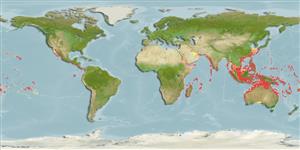
Indo-Pacific: Red Sea and East Africa to the Society Islands, north to southern Japan and Hawaii, south to the Lord Howe Island. Eastern Pacific: Gulf of California to Panama and the Galapagos Islands (Ref. 5227).
Taille / Poids / Âge
Maturité: Lm ? range ? - ? cm
Max length : 42.0 cm TL mâle / non sexé; (Ref. 97145)
Description synthétique
Clés d'identification | Morphologie | Morphométrie
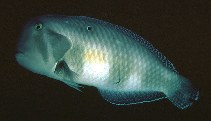
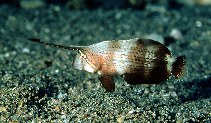
Épines dorsales (Total) : 9; Rayons mous dorsaux (Total) : 12 - 13; Épines anales: 3; Rayons mous anaux: 12 - 13. Identified by the dark vertical bar below the eye. Usually with 5 dark bars when adult and belly of female turns red. Juveniles with black anal fin and two large ocelli, thinly edged with white, in dorsal fin (Ref. 48636). First two dorsal spines form a separate fin. Juveniles this fin forms a long, bannerlike filament but shortens with age (Ref. 37816).
Body shape (shape guide): fusiform / normal; Cross section: compressed.
Usually solitary in lagoon and seaward reef areas with fine to loose, coarse sand bottoms (Ref. 1602). Juveniles sometimes in shallow estuaries (Ref. 48636). Adults rare in less than 20 m (Ref. 9710). Benthic and benthopelagic (Ref. 58302). Dives into sand to sleep safely at night or to hide when alarmed (Ref. 9311, 90102). Feed on hard-shelled invertebrates, including mollusks and crustaceans (Ref. 9311). Juveniles mimic drifting dead leaves by holding the elongate detached front part of dorsal fin forward over head. Good to eat, flesh very white (Ref. 7364). Minimum depth reported from Ref. 27115.
Cycle de vie et comportement reproducteur
Maturité | Reproduction | Frai | Œufs | Fécondité | Larves
Distinct pairing during breeding (Ref. 205).
Randall, J.E., G.R. Allen and R.C. Steene, 1990. Fishes of the Great Barrier Reef and Coral Sea. University of Hawaii Press, Honolulu, Hawaii. 506 p. (Ref. 2334)
Statut dans la liste rouge de l'IUCN (Ref. 130435: Version 2025-2 (Global))
Utilisations par l'homme
Pêcheries: commercial; pêche sportive: oui; Aquarium: Commercial
Outils
Articles particuliers
Télécharger en XML
Sources Internet
Estimations basées sur des modèles
Température préférée (Réf.
123201): 24.2 - 29, mean 27.8 °C (based on 1216 cells).
Indice de diversité phylogénétique (Réf.
82804): PD
50 = 0.5000 [Uniqueness, from 0.5 = low to 2.0 = high].
Bayesian length-weight: a=0.01072 (0.00537 - 0.02137), b=3.09 (2.91 - 3.27), in cm total length, based on LWR estimates for this species & (Sub)family-body (Ref.
93245).
Niveau trophique (Réf.
69278): 3.5 ±0.46 se; based on food items.
Résilience (Réf.
120179): Milieu, temps minimum de doublement de population : 1,4 à 4,4 années (Preliminary K or Fecundity.).
Vulnérabilité de la pêche (Ref.
59153): Low to moderate vulnerability (32 of 100).
🛈
Nutriments (Ref.
124155): Calcium = 40.6 [24.7, 63.2] mg/100g; Iron = 0.54 [0.32, 0.96] mg/100g; Protein = 18.5 [15.7, 20.7] %; Omega3 = 0.146 [0.101, 0.214] g/100g; Selenium = 37 [24, 60] μg/100g; VitaminA = 95.6 [31.2, 328.0] μg/100g; Zinc = 1.26 [0.92, 1.92] mg/100g (wet weight);