>
Pleuronectiformes (Flatfishes) >
Pleuronectidae (Righteye flounders) > Hippoglossinae
Etymology: Hippoglossus: Greek, ippos = horse + Greek, glossa = tongue (Ref. 45335); stenolepis: From the Greek hippos (horse), glossa (tounge), steno (narrow), lepis, (scale). In 1904, a Russian scientist by the name of P.J. Schmidt first proposed the scientific name based on anatomical differences such as scale shape, pectoral fin length, and body shape which he thought distinguished it from the Atlantic halibut (Hippoglossus hippoglossus). (Ref. 94075).
Môi trường: môi trường / vùng khí hậu / Mức độ sâu / phạm vi phân phối
Sinh thái học
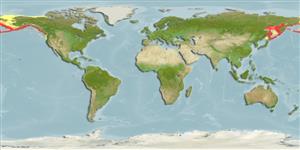
biển gần đáy; Ở đại duơng, biển (Ref. 138310); mức độ sâu 0 - 1200 m (Ref. 50550). Temperate; 73°N - 42°N, 138°E - 123°W (Ref. 54557)
North Pacific: Hokkaido, Japan and the Sea of Okhotsk to the southern Chukchi Sea and Point Camalu, Baja California, Mexico.
Chiều dài lúc trưởng thành đầu tiên / Bộ gần gũi / Khối lượng (Trọng lượng) / Tuổi
Chín muồi sinh dục: Lm ? range ? - ? cm
Max length : 258 cm TL con đực/không giới tính; (Ref. 40637); 267.0 cm TL (female); Khối lượng cực đại được công bố: 363.0 kg (Ref. ); Tuổi cực đại được báo cáo: 55 các năm (Ref. 55701)
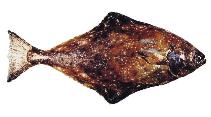
Các tia vây lưng cứng (tổng cộng) : 0; Các vây lưng mềm (tổng cộng) : 90 - 106; Tia cứng vây hậu môn: 0; Tia mềm vây hậu môn: 69 - 80; Động vật có xương sống: 49 - 51. Dorsal origin above anterior part of pupil in upper eye, generally low, higher in middle. Caudal spread and slightly lunate. Pectorals small.
Body shape (shape guide): fusiform / normal.
Found on various types of bottoms (Ref. 2850). Young are found near shore, moving out to deeper waters as they grow older (Ref. 6885). Older individuals typically move from deeper water along the edge of the continental shelf where they spend the winter, to shallow coastal water (27-274 m) for the summer (Ref. 28499). Feed on fishes, crabs, clams, squids, and other invertebrates (Ref. 6885). Utilized fresh, dried or salted, smoked and frozen; eaten steamed, fried, broiled, boiled, microwaved and baked (Ref. 9988).
Vinnikov, K.A., R.C. Thomson and T.A. Munroe, 2018. Revised classification of the righteye flounders (Teleostei: Pleuronectidae) based on multilocus phylogeny with complete taxon sampling. Molecular phylogenetics and evolution, 125:147-162. (Ref. 122998)
Tình trạng Sách đỏ IUCN (Ref. 130435: Version 2025-2 (Global))
Mối đe dọa đối với con người
Harmless
Sử dụng của con người
Các nghề cá: tính thương mại cao; cá để chơi: đúng; Bể nuôi cá: Bể cá công cộng
Các công cụ
Báo cáo đặc biệt
Tải xuống XML
Các nguồn internet
Ước tính dựa trên mô hình
Nhiệt độ ưa thích (Tài liệu tham khảo
123201): 0.3 - 5.7, mean 1.6 °C (based on 454 cells).
Chỉ số đa dạng phát sinh loài (Tài liệu tham khảo
82804): PD
50 = 0.7500 [Uniqueness, from 0.5 = low to 2.0 = high].
Bayesian length-weight: a=0.00631 (0.00396 - 0.01004), b=3.14 (3.00 - 3.28), in cm total length, based on LWR estimates for this species & (Sub)family-body (Ref.
93245).
Mức dinh dưỡng (Tài liệu tham khảo
69278): 4.1 ±0.2 se; based on diet studies.
Thích nghi nhanh (Tài liệu tham khảo
120179): Rất thấp, thời gian nhân đôi của chủng quần tối thiểu là hơn 14 năm (rm=0.2; K=0.05; tm=5-20; tmax=55).
Prior r = 0.11, 95% CL = 0.07 - 0.17, Based on 3 full stock assessments.
Sự dễ bị tổn thương của nghề đánh cá (Ref.
59153): Very high vulnerability (86 of 100).
🛈
Sự dễ bị tổn thương của khí hậu (Ref.
125649): Moderate to high vulnerability (45 of 100).
🛈
Chất dinh dưỡng (Ref.
124155): Calcium = 8.89 [2.92, 21.69] mg/100g; Iron = 0.202 [0.078, 0.561] mg/100g; Protein = 18 [16, 20] %; Omega3 = 0.391 [0.169, 0.895] g/100g; Selenium = 42.3 [14.7, 110.0] μg/100g; VitaminA = 10.8 [2.5, 41.8] μg/100g; Zinc = 0.412 [0.179, 0.699] mg/100g (wet weight);