>
Pleuronectiformes (Flatfishes) >
Pleuronectidae (Righteye flounders) > Hippoglossinae
Etymology: Hippoglossus: Greek, ippos = horse + Greek, glossa = tongue (Ref. 45335); stenolepis: From the Greek hippos (horse), glossa (tounge), steno (narrow), lepis, (scale). In 1904, a Russian scientist by the name of P.J. Schmidt first proposed the scientific name based on anatomical differences such as scale shape, pectoral fin length, and body shape which he thought distinguished it from the Atlantic halibut (Hippoglossus hippoglossus). (Ref. 94075).
Umwelt: Milieu / Klimazone / Tiefenbereich / Verbreitungsgebiet
Ökologie
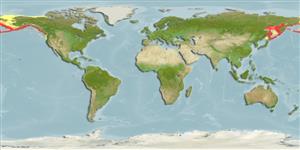
seewasser demersal; ozeanodrom (Ref. 138310); tiefenbereich 0 - 1200 m (Ref. 50550). Temperate; 73°N - 42°N, 138°E - 123°W (Ref. 54557)
North Pacific: Hokkaido, Japan and the Sea of Okhotsk to the southern Chukchi Sea and Point Camalu, Baja California, Mexico.
Länge bei der ersten Reifung / Größe / Gewicht / Alter
Geschlechtsreife: Lm ? range ? - ? cm
Max length : 258 cm TL Männchen/unbestimmt; (Ref. 40637); 267.0 cm TL (female); max. veröff. Gewicht: 363.0 kg (Ref. ); max. veröff. Alter: 55 Jahre (Ref. 55701)
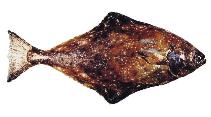
Rückenflossenstacheln (insgesamt) : 0; Rückenflossenweichstrahlen (insgesamt) : 90 - 106; Afterflossenstacheln: 0; Afterflossenweichstrahlen: 69 - 80; Wirbelzahl: 49 - 51. Dorsal origin above anterior part of pupil in upper eye, generally low, higher in middle. Caudal spread and slightly lunate. Pectorals small.
Body shape (shape guide): fusiform / normal.
Found on various types of bottoms (Ref. 2850). Young are found near shore, moving out to deeper waters as they grow older (Ref. 6885). Older individuals typically move from deeper water along the edge of the continental shelf where they spend the winter, to shallow coastal water (27-274 m) for the summer (Ref. 28499). Feed on fishes, crabs, clams, squids, and other invertebrates (Ref. 6885). Utilized fresh, dried or salted, smoked and frozen; eaten steamed, fried, broiled, boiled, microwaved and baked (Ref. 9988).
Vinnikov, K.A., R.C. Thomson and T.A. Munroe, 2018. Revised classification of the righteye flounders (Teleostei: Pleuronectidae) based on multilocus phylogeny with complete taxon sampling. Molecular phylogenetics and evolution, 125:147-162. (Ref. 122998)
IUCN Rote Liste Status (Ref. 130435: Version 2025-2 (Global))
Bedrohung für Menschen
Harmless
Nutzung durch Menschen
Fischereien: hoch kommerziell; Sportfisch: ja; Aquarium: Öffentliche Aquarien
Tools
Zusatzinformationen
Download XML
Internet Quellen
Schätzungen auf der Grundlage von Modellen
Bevorzugte Temperatur (Ref.
123201): 0.3 - 5.7, mean 1.6 °C (based on 454 cells).
Phylogenetischer Diversitätsindex (Ref.
82804): PD
50 = 0.7500 [Uniqueness, from 0.5 = low to 2.0 = high].
Bayesian length-weight: a=0.00631 (0.00396 - 0.01004), b=3.14 (3.00 - 3.28), in cm total length, based on LWR estimates for this species & (Sub)family-body (Ref.
93245).
Trophische Ebene (Ref.
69278): 4.1 ±0.2 se; based on diet studies.
Widerstandsfähigkeit (Ref.
120179): sehr niedrig, Verdopplung der Population dauert mehr als 14 Jahre. (rm=0.2; K=0.05; tm=5-20; tmax=55).
Prior r = 0.11, 95% CL = 0.07 - 0.17, Based on 3 full stock assessments.
Anfälligkeit der Fischerei (Ref.
59153): Very high vulnerability (86 of 100).
🛈
Klimaanfälligkeit (Ref.
125649): Moderate to high vulnerability (45 of 100).
🛈
Nährstoffe (Ref.
124155): Calcium = 8.89 [2.92, 21.69] mg/100g; Iron = 0.202 [0.078, 0.561] mg/100g; Protein = 18 [16, 20] %; Omega3 = 0.391 [0.169, 0.895] g/100g; Selenium = 42.3 [14.7, 110.0] μg/100g; VitaminA = 10.8 [2.5, 41.8] μg/100g; Zinc = 0.412 [0.179, 0.699] mg/100g (wet weight);