>
Ophidiiformes (Cusk eels) >
Ophidiidae (Cusk-eels) > Ophidiinae
Etymology: Genypterus: Greek, geny, -yos = face, jaw + Greek, pteron, = wing, fin (Ref. 45335).
More on author: Forster.
Entorno: milieu / zona climática / rango de profundidad / gama de distribución
Ecología
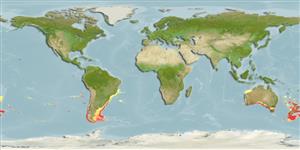
marino batidemersal; oceanodromo (Ref. 51243); rango de profundidad 22 - 1000 m (Ref. 58489), usually 300 - 550 m (Ref. 6390). Deep-water; 17°S - 57°S, 114°E - 30°W (Ref. 34024)
Southwest Pacific: southern Australia and around New Zealand. Southeast Pacific: Chile (Ref. 9068). Southwest Atlantic: Brazil (Ref. 4517).
Longitud en la primera madurez / Tamaño / Peso / Edad
Madurez: Lm 72.0 range ? - ? cm
Max length : 200 cm SL macho / no sexado; (Ref. 34024); common length : 100.0 cm TL macho / no sexado; (Ref. 9258); peso máximo publicado: 25.0 kg (Ref. 34024); edad máxima reportada: 46 años (Ref. 128769)
Descripción breve
Claves de identificación | Morfología | Morfometría
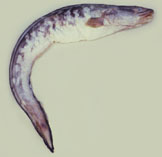
Espinas dorsales (total) : 0; Radios blandos dorsales (total) : 141 - 164; Espinas anales: 0; Radios blandos anales: 101 - 126; Vértebra: 68 - 70. Body pinkish yellow, marbled with irregular reddish brown blotches dorsally (Ref. 27363).
Body shape (shape guide): elongated; Cross section: compressed.
Common species (Ref. 34024). Found between depths of 22 m (Ref. 58489) and 1000 m (Ref. 33848). Feed mainly on crustaceans such as Munida and scampi and also on fish. Also caught above the bottom when feeding on hoki (Macruronus novaezelandiae) during the hoki spawning season. Available all year round. Juveniles are found in shallower shelf waters (Ref. 6390). Oviparous, with oval pelagic eggs floating in a gelatinous mass (Ref. 205). Utilized fresh, frozen or smoked; can be fried and baked (Ref. 9988, 34024).
Nielsen, J.G., D.M. Cohen, D.F. Markle and C.R. Robins, 1999. Ophidiiform fishes of the world (Order Ophidiiformes). An annotated and illustrated catalogue of pearlfishes, cusk-eels, brotulas and other ophidiiform fishes known to date. FAO Fish. Synop. 125(18):178p. Rome: FAO. (Ref. 34024)
Situación en la Lista Roja de la UICN (Ref. 130435: Version 2025-2 (Global))
Amenaza para el ser humano
Harmless
Usos humanos
Pesquerías: muy comercial
Herramientas
Informes especiales
Descargar XML
Fuentes de Internet
Estimaciones basadas en modelos
Temperatura preferida (Referencia
123201): 3.3 - 12.7, mean 7.2 °C (based on 279 cells).
Índice de diversidad filogenética (Referencia
82804): PD
50 = 0.5156 [Uniqueness, from 0.5 = low to 2.0 = high].
Bayesian length-weight: a=0.00219 (0.00133 - 0.00361), b=3.16 (3.01 - 3.31), in cm total length, based on LWR estimates for this species & (Sub)family-body (Ref.
93245).
Nivel trófico (Referencia
69278): 4.2 ±0.76 se; based on food items.
Generation time: 11.0 (8.6 - 12.6) years. Estimated as median ln(3)/K based on 10
growth studies.
Resiliencia (Referencia
120179): Bajo, población duplicada en un tiempo mínimo de 4.5-14 años (K=0.1-0.23; tmax=30; tm=5-7).
Prior r = 0.25, 95% CL = 0.16 - 0.37, Based on 4 full stock assessments.
Vulnerabilidad pesquera (Ref.
59153): Very high vulnerability (84 of 100).
🛈
Vulnerabilidad climática (Ref.
125649): Moderate vulnerability (44 of 100).
🛈
Nutrientes (Ref.
124155): Calcium = 11.8 [7.2, 25.7] mg/100g; Iron = 0.365 [0.190, 0.713] mg/100g; Protein = 15.6 [13.6, 17.7] %; Omega3 = 0.255 [0.136, 0.502] g/100g; Selenium = 31.6 [14.3, 70.0] μg/100g; VitaminA = 6.94 [1.54, 32.25] μg/100g; Zinc = 0.234 [0.157, 0.351] mg/100g (wet weight); based on
nutrient studies.