Окружающая среда: среда / климатическая зона / пределы глубины / диапазон распространения
экология
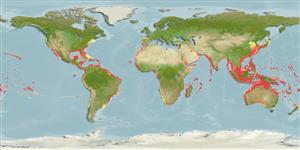
морской ассоциированный с рифами; пределы глубины 2 - 200 m (Ref. 5951), usually 2 - 35 m (Ref. 40849). Subtropical; 37°N - 39°S, 8°E - 55°W (Ref. 55210)
Circumtropical in distribution. Western Atlantic: Canada (Ref. 5951), Florida, USA and the Bahamas to Brazil (Ref. 7251). Eastern Atlantic: 30°N to 23°S (Ref. 6951); also South Africa (Ref. 4423). Western Indian Ocean: southern Red Sea to Madagascar, Reunion and Mauritius (Ref. 53568). Pacific Ocean: southern Japan south to Lord Howe Island and east to the Hawaiian and Easter islands (Ref. 37816). Also from southern California, USA to Colombia (Ref. 11482) and the Galapagos Islands (Ref. 5227).
Размер / Вес / Возраст
половая зрелость: Lm ? range ? - ? cm
Max length : 50.0 cm TL самец/пол неопределен; (Ref. 7251); common length : 15.0 cm TL самец/пол неопределен; (Ref. 55763)
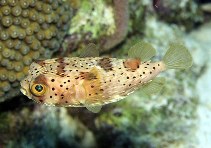
колючие лучи спинного плавника (общее число) : 0; членистые (мягкие) лучи спинного плавника (общее число) : 13 - 15; колючие лучи анального плавника: 0; членистые (мягкие) лучи анального плавника: 13 - 15. Pelagic juveniles with spots, particularly prominent on belly; adults with dark blotches across back and spots between the blotches; fins without spots (Ref. 4423). 14 to 16 spines in an approximate row between snout and origin of dorsal fin; with a large brown bar above and below each eye; a broad transverse brown bar on occipital region of head (Ref. 13442).
Body shape (shape guide): short and / or deep.
Inhabit shallow reefs to open, soft bottoms. Also in areas with rocky substrata. Sometimes form groups (Ref. 9710, 48637). Occur on open muddy substrates as well as on rich soft-bottom and coral reefs. Juveniles often with floating Sargassum rafts. Young and sub-adults may form small groups (Ref. 48637). Benthopelagic (Ref. 58302). Juveniles pelagic to about 6-9 cm. Solitary. Feed on mollusks, sea urchins, hermit crabs, and crabs at night (Ref. 9680). Relatively poor swimmers (Ref. 9710). Used in Chinese medicine (Ref. 12166). Captured at the surface using a hand net (Ref. 26165).
Жизненный цикл и брачное поведение
половая зрелость | размножение | нерест | икра | Плодовитость | личинки
Leis, J.M., 1984. Diodontidae. In W. Fischer and G. Bianchi (eds.) FAO species identification sheets for fishery purposes. Western Indian Ocean fishing area 51. Vol. 2. (Ref. 3393)
Статус Красного Списка МСОП (Ref. 130435: Version 2025-2 (Global))
Угроза для людей
Reports of ciguatera poisoning (Ref. 30303)
Использование человеком
рыболовство: не имеет хозяйственного значения; объект спортивного рыболовства: да; аквариум: коммерческий
дополнительная информация
инструменты
Специальные отчеты
Скачать в формате XML
ресурсы в Интернет
Оценки, основанные на моделях
Предпочтительная температура (ссылка
123201): 21.5 - 29, mean 27.3 °C (based on 2666 cells).
Индекс филогенетического разнообразия (ссылка
82804): PD
50 = 0.5313 [Uniqueness, from 0.5 = low to 2.0 = high].
Bayesian length-weight: a=0.05888 (0.02860 - 0.12123), b=2.80 (2.61 - 2.99), in cm total length, based on LWR estimates for this species & (Sub)family-body (Ref.
93245).
Трофический уровень (ссылка
69278): 3.9 ±0.2 se; based on diet studies.
Generation time: 2.1 ( na - na) years. Estimated as median ln(3)/K based on 1
growth studies.
устойчивость к внешним воздействиям (ссылка
120179): высокий, минимальное время удвоения популяции до 15 месяцев (Preliminary K or Fecundity.).
Уязвимость рыбной ловли (Ref.
59153): Low to moderate vulnerability (27 of 100).
🛈
Питательные вещества (Ref.
124155): Calcium = 20.4 [7.6, 77.9] mg/100g; Iron = 0.566 [0.268, 1.420] mg/100g; Protein = 19.3 [17.1, 21.5] %; Omega3 = 0.201 [0.104, 0.390] g/100g; Selenium = 24.7 [10.4, 57.1] μg/100g; VitaminA = 22.8 [5.5, 106.7] μg/100g; Zinc = 0.535 [0.334, 0.862] mg/100g (wet weight);