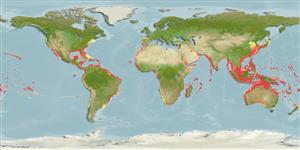
Ambiente: milieu / zona climatica / distribuzione batimetrica / gamma di distribuzione
Ecologia
marino associati a barriera corallina; distribuzione batimetrica 2 - 200 m (Ref. 5951), usually 2 - 35 m (Ref. 40849). Subtropical; 37°N - 39°S, 8°E - 55°W (Ref. 55210)
Circumtropical in distribution. Western Atlantic: Canada (Ref. 5951), Florida, USA and the Bahamas to Brazil (Ref. 7251). Eastern Atlantic: 30°N to 23°S (Ref. 6951); also South Africa (Ref. 4423). Western Indian Ocean: southern Red Sea to Madagascar, Reunion and Mauritius (Ref. 53568). Pacific Ocean: southern Japan south to Lord Howe Island and east to the Hawaiian and Easter islands (Ref. 37816). Also from southern California, USA to Colombia (Ref. 11482) and the Galapagos Islands (Ref. 5227).
Dimensione / Peso / Età
Maturità: Lm ? range ? - ? cm
Max length : 50.0 cm TL maschio/sesso non determinato; (Ref. 7251); common length : 15.0 cm TL maschio/sesso non determinato; (Ref. 55763)
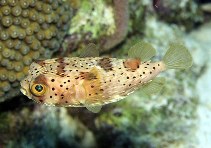
Spine dorsali (totale) : 0; Raggi dorsali molli (totale) : 13 - 15; Spine anali: 0; Raggi anali molli: 13 - 15. Pelagic juveniles with spots, particularly prominent on belly; adults with dark blotches across back and spots between the blotches; fins without spots (Ref. 4423). 14 to 16 spines in an approximate row between snout and origin of dorsal fin; with a large brown bar above and below each eye; a broad transverse brown bar on occipital region of head (Ref. 13442).
Body shape (shape guide): short and / or deep.
Inhabit shallow reefs to open, soft bottoms. Also in areas with rocky substrata. Sometimes form groups (Ref. 9710, 48637). Occur on open muddy substrates as well as on rich soft-bottom and coral reefs. Juveniles often with floating Sargassum rafts. Young and sub-adults may form small groups (Ref. 48637). Benthopelagic (Ref. 58302). Juveniles pelagic to about 6-9 cm. Solitary. Feed on mollusks, sea urchins, hermit crabs, and crabs at night (Ref. 9680). Relatively poor swimmers (Ref. 9710). Used in Chinese medicine (Ref. 12166). Captured at the surface using a hand net (Ref. 26165).
Ciclo vitale e comportamento di accoppiamento
Maturità | Riproduzione | Deposizione | Uova | Fecondità | Larve
Leis, J.M., 1984. Diodontidae. In W. Fischer and G. Bianchi (eds.) FAO species identification sheets for fishery purposes. Western Indian Ocean fishing area 51. Vol. 2. (Ref. 3393)
Stato della Lista Rossa IUCN (Ref. 130435: Version 2025-2 (Global))
Minaccia per l'uomo
Reports of ciguatera poisoning (Ref. 30303)
Usi umani
Pesca: scarso interesse commerciale; Pesce da pesca sportiva: si; Acquario: Commerciale
Strumenti
Rapporti speciali
Scarica XML
Fonti Internet
Stime basate su modelli
Temperatura preferita (Fonte Biblio.
123201): 21.5 - 29, mean 27.3 °C (based on 2666 cells).
Indice di diversità filogenetica (Fonte Biblio.
82804): PD
50 = 0.5313 [Uniqueness, from 0.5 = low to 2.0 = high].
Bayesian length-weight: a=0.05888 (0.02860 - 0.12123), b=2.80 (2.61 - 2.99), in cm total length, based on LWR estimates for this species & (Sub)family-body (Ref.
93245).
Livello trofico (Fonte Biblio.
69278): 3.9 ±0.2 se; based on diet studies.
Generation time: 2.1 ( na - na) years. Estimated as median ln(3)/K based on 1
growth studies.
Resilienza (Fonte Biblio.
120179): Alto, tempo minimo di raddoppiamento della popolazione meno di 15 mesi (Preliminary K or Fecundity.).
Vulnerabilità della pesca (Ref.
59153): Low to moderate vulnerability (27 of 100).
🛈
Nutrienti (Ref.
124155): Calcium = 20.4 [7.6, 77.9] mg/100g; Iron = 0.566 [0.268, 1.420] mg/100g; Protein = 19.3 [17.1, 21.5] %; Omega3 = 0.201 [0.104, 0.390] g/100g; Selenium = 24.7 [10.4, 57.1] μg/100g; VitaminA = 22.8 [5.5, 106.7] μg/100g; Zinc = 0.535 [0.334, 0.862] mg/100g (wet weight);