>
Perciformes/Scorpaenoidei (Scorpionfishes) >
Sebastidae (Rockfishes, rockcods and thornyheads) > Sebastinae
Etymology: Sebastes: Greek, sebastes = august, venerable (Ref. 45335); auriculatus: From the Latin auriculatus, meaning 'eared' (Ref. 27436).
More on author: Girard.
Ambiente: milieu / zona climática / intervalo de profundidade / gama de distribuição
Ecologia
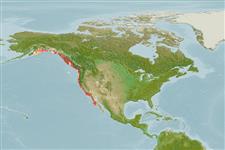
marinhas demersal; intervalo de profundidade 0 - 128 m (Ref. 27437). Temperate; ? - 15°C (Ref. 131058); 62°N - 27°N, 155°W - 113°W
Eastern Pacific: Prince William Sound, Alaska to central Baja California, Mexico.
Comprimento na primeira maturidade / Tamanho / Peso / Idade
Maturidade: Lm 31.0, range 26 - 38 cm
Max length : 56.0 cm TL macho/indeterminado; (Ref. 27437); Idade máx. registada: 34 anos (Ref. 56049)
Descrição breve
Chaves de identificação | Morfologia | Morfometria
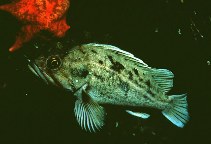
Espinhos dorsais (total) : 13; Raios dorsais moles (total) : 12 - 15; Espinhos anais: 3; Raios anais moles: 5 - 8; Vértebras: 26 - 27. Head spines strong - nasal, preocular, postocular, tympanic, coronal (may be absent), parietal, and nuchal (may be absent) spines present, supraoculars absent (Ref. 27437). Interorbital space flat to barely convex; symphyseal knob weak or absent (Ref. 27437). Caudal fin rounded (Ref. 6885). Light brown, mottled with one or two shades of darker brown, vague dark bars dorsally, dark brown blotch on upper part of gill cover; fins and underside of throat and lower jaw pinkish (Ref. 27437). Branchiostegal rays: 7 (Ref. 36715).
A sedentary rockfish found in shallow water and bays (Ref. 2850), among sheltering weed-covered rocks or around pilings (Ref. 27436). Viviparous, with planktonic larvae and pelagic juveniles (Ref. 36715). Fin spines are sharp and mildly venomous and can cause annoying wounds (Ref. 27436). Small live specimens make excellent bait for large lingcod (Ref. 27436). Flesh is firm and tasty, but rarely found in markets (Ref. 26346).
Eschmeyer, W.N., E.S. Herald and H. Hammann, 1983. A field guide to Pacific coast fishes of North America. Boston (MA, USA): Houghton Mifflin Company. xii+336 p. (Ref. 2850)
Categoria na Lista Vermelha da IUCN (Ref. 130435: Version 2025-2 (Global))
Utilização humana
Pescarias: pouco comercial; peixe desportivo: sim; Aquário: Aquários públicos; isco: occasionally
Ferramentas
Relatórios especiais
Descarregue XML
Fontes da internet
Estimativas baseadas em modelos
Temperatura preferida (Ref.
123201): 8 - 12.8, mean 9.7 °C (based on 80 cells).
Índice de diversidade filogenética (Ref.
82804): PD
50 = 0.5000 [Uniqueness, from 0.5 = low to 2.0 = high].
Bayesian length-weight: a=0.01000 (0.00490 - 0.02040), b=3.09 (2.92 - 3.26), in cm total length, based on LWR estimates for this Genus-body shape (Ref.
93245).
Nível Trófico (Ref.
69278): 4.0 ±0.62 se; based on food items.
Resiliência (Ref.
120179): Baixo, tempo mínimo de duplicação da população 4,5 - 14 anos (tmax=34; tm=5).
Prior r = 0.19, 95% CL = 0.13 - 0.29, Based on 2 full stock assessments.
Vulnerabilidade da pesca (Ref.
59153): Moderate vulnerability (42 of 100).
🛈
Nutrientes (Ref.
124155): Calcium = 23.4 [8.7, 72.9] mg/100g; Iron = 0.241 [0.100, 0.565] mg/100g; Protein = 18.2 [17.0, 19.3] %; Omega3 = 1.14 [0.47, 2.78] g/100g; Selenium = 31.1 [12.4, 94.1] μg/100g; VitaminA = 24.2 [7.7, 76.5] μg/100g; Zinc = 0.356 [0.189, 0.635] mg/100g (wet weight);