>
Perciformes/Scorpaenoidei (Scorpionfishes) >
Sebastidae (Rockfishes, rockcods and thornyheads) > Sebastinae
Etymology: Sebastes: Greek, sebastes = august, venerable (Ref. 45335); auriculatus: From the Latin auriculatus, meaning 'eared' (Ref. 27436).
More on author: Girard.
Ambiente: milieu / zona climatica / distribuzione batimetrica / gamma di distribuzione
Ecologia
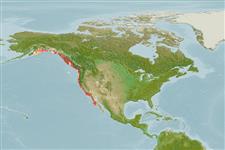
marino demersale; distribuzione batimetrica 0 - 128 m (Ref. 27437). Temperate; ? - 15°C (Ref. 131058); 62°N - 27°N, 155°W - 113°W
Eastern Pacific: Prince William Sound, Alaska to central Baja California, Mexico.
Lunghezza alla prima maturità / Dimensione / Peso / Età
Maturità: Lm 31.0, range 26 - 38 cm
Max length : 56.0 cm TL maschio/sesso non determinato; (Ref. 27437); Età massima riportata: 34 anni (Ref. 56049)
Breve descrizione
Chiavi di identificazione | Morfologia | Morfometria
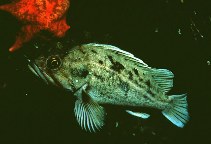
Spine dorsali (totale) : 13; Raggi dorsali molli (totale) : 12 - 15; Spine anali: 3; Raggi anali molli: 5 - 8; Vertebre: 26 - 27. Head spines strong - nasal, preocular, postocular, tympanic, coronal (may be absent), parietal, and nuchal (may be absent) spines present, supraoculars absent (Ref. 27437). Interorbital space flat to barely convex; symphyseal knob weak or absent (Ref. 27437). Caudal fin rounded (Ref. 6885). Light brown, mottled with one or two shades of darker brown, vague dark bars dorsally, dark brown blotch on upper part of gill cover; fins and underside of throat and lower jaw pinkish (Ref. 27437). Branchiostegal rays: 7 (Ref. 36715).
A sedentary rockfish found in shallow water and bays (Ref. 2850), among sheltering weed-covered rocks or around pilings (Ref. 27436). Viviparous, with planktonic larvae and pelagic juveniles (Ref. 36715). Fin spines are sharp and mildly venomous and can cause annoying wounds (Ref. 27436). Small live specimens make excellent bait for large lingcod (Ref. 27436). Flesh is firm and tasty, but rarely found in markets (Ref. 26346).
Eschmeyer, W.N., E.S. Herald and H. Hammann, 1983. A field guide to Pacific coast fishes of North America. Boston (MA, USA): Houghton Mifflin Company. xii+336 p. (Ref. 2850)
Stato della Lista Rossa IUCN (Ref. 130435: Version 2025-2 (Global))
Usi umani
Pesca: scarso interesse commerciale; Pesce da pesca sportiva: si; Acquario: Acquari pubblici; esca: occasionally
Strumenti
Rapporti speciali
Scarica XML
Fonti Internet
Stime basate su modelli
Temperatura preferita (Fonte Biblio.
123201): 8 - 12.8, mean 9.7 °C (based on 80 cells).
Indice di diversità filogenetica (Fonte Biblio.
82804): PD
50 = 0.5000 [Uniqueness, from 0.5 = low to 2.0 = high].
Bayesian length-weight: a=0.01000 (0.00490 - 0.02040), b=3.09 (2.92 - 3.26), in cm total length, based on LWR estimates for this Genus-body shape (Ref.
93245).
Livello trofico (Fonte Biblio.
69278): 4.0 ±0.62 se; based on food items.
Resilienza (Fonte Biblio.
120179): Basso, tempo minimo di raddoppiamento della popolazione 4.5 - 14 anni (tmax=34; tm=5).
Prior r = 0.19, 95% CL = 0.13 - 0.29, Based on 2 full stock assessments.
Vulnerabilità della pesca (Ref.
59153): Moderate vulnerability (42 of 100).
🛈
Nutrienti (Ref.
124155): Calcium = 23.4 [8.7, 72.9] mg/100g; Iron = 0.241 [0.100, 0.565] mg/100g; Protein = 18.2 [17.0, 19.3] %; Omega3 = 1.14 [0.47, 2.78] g/100g; Selenium = 31.1 [12.4, 94.1] μg/100g; VitaminA = 24.2 [7.7, 76.5] μg/100g; Zinc = 0.356 [0.189, 0.635] mg/100g (wet weight);