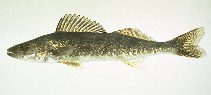
Окружающая среда: среда / климатическая зона / пределы глубины / диапазон распространения
экология
; пресноводный; солоноватоводный донно-пелагический; мигрирует в реке (Ref. 126106); пределы глубины 0 - 27 m (Ref. 11002). Subtropical; 1°C - 29°C (Ref. 12741); 70°N - 30°N, 137°W - 69°W (Ref. 86798)
North America: St. Lawrence-Great Lakes, Arctic, and Mississippi River basins from Quebec to Northwest Territories in Canada, and south to Alabama and Arkansas in the USA; possibly native to Mobile Bay basin. Widely introduced elsewhere in the USA, including Atlantic and Pacific drainages.
Длина при первой зрелости / Размер / Вес / Возраст
половая зрелость: Lm 42.5, range 36 - 44.8 cm
Max length : 107 cm FL самец/пол неопределен; (Ref. 1998); common length : 54.0 cm TL самец/пол неопределен; (Ref. 12193); наибольший вес (опубликованные данные): 11.3 kg (Ref. 4699); наибольший возраст (опубликованны данные): 29 годы (Ref. 12193)
колючие лучи спинного плавника (общее число) : 13 - 17; членистые (мягкие) лучи спинного плавника (общее число) : 18 - 22; колючие лучи анального плавника: 2; членистые (мягкие) лучи анального плавника: 11 - 14; позвонки: 44 - 48. Nuptial tubercles absent. Differentiation of sexes difficult. Branchiostegal rays 7,7 or 7,8 (Ref. 1998).
Body shape (shape guide): elongated; Cross section: compressed.
Adults occur in lakes, pools, backwaters, and runs of medium to large rivers. Frequently found in clear water, usually near brush (Ref. 86798). They prefer large, shallow lakes with high turbidity (Ref. 9988, 10294). Rarely found in brackish waters (Ref. 1998). They feed at night, mainly on insects and fishes (with preference for yellow perch and freshwater drum but will take any fish available) also feed on crayfish, snails, frogs, mudpuppies, and small mammals when fish and insects are scarce (Ref. 1998). Although not widely farmed commercially for consumption, large numbers are hatched and raised for stocking lakes for game fishing (Ref. 9988). Utilized fresh or frozen; eaten pan-fried, broiled, microwaved and baked (Ref. 9988).
Spawning occurs in small groups (a larger female and two smaller males or two females and up to six males) that engage in chasing, circular swimming, and fin erection. The group then ascends to shallow water, females roll on their side, and eggs and sperm are released. Deposition of eggs usually occurs in a single night (Ref. 1998). Larvae pelagic (Ref. 7471).
Page, L.M. and B.M. Burr, 2011. A field guide to freshwater fishes of North America north of Mexico. Boston : Houghton Mifflin Harcourt, 663p. (Ref. 86798)
Статус Красного Списка МСОП (Ref. 130435: Version 2025-2 (Global))
Угроза для людей
Harmless
Использование человеком
рыболовство: коммерческий; аквакультура (рыбоводство): экспериментальный; объект спортивного рыболовства: да; аквариум: общественные аквариумы
дополнительная информация
инструменты
Специальные отчеты
Скачать в формате XML
ресурсы в Интернет
Оценки, основанные на моделях
Индекс филогенетического разнообразия (ссылка
82804): PD
50 = 0.5312 [Uniqueness, from 0.5 = low to 2.0 = high].
Bayesian length-weight: a=0.00631 (0.00481 - 0.00827), b=3.15 (3.07 - 3.23), in cm total length, based on LWR estimates for this species (Ref.
93245).
Трофический уровень (ссылка
69278): 4.5 ±0.0 se; based on diet studies.
Generation time: 3.7 (3.0 - 3.8) years. Estimated as median ln(3)/K based on 42
growth studies.
устойчивость к внешним воздействиям (ссылка
120179): низкий, минимальное время удвоения популяции 4.5-14 лет (K=0.05-0.45; tm=2-4; tmax=29; Fec=41,061).
Уязвимость рыбной ловли (Ref.
59153): Moderate to high vulnerability (45 of 100).
🛈
Питательные вещества (Ref.
124155): Calcium = 83.9 [34.8, 196.2] mg/100g; Iron = 0.483 [0.192, 1.201] mg/100g; Protein = 18.1 [16.9, 19.3] %; Omega3 = 0.17 [0.07, 0.35] g/100g; Selenium = 7.44 [1.82, 31.88] μg/100g; VitaminA = 18.6 [6.9, 51.0] μg/100g; Zinc = 0.913 [0.526, 1.539] mg/100g (wet weight); based on
nutrient studies.