Lingkungan: lingkungan / zona iklim / kisaran kedalaman / jangkauan distribusi
Ekologi
; air tawar; payau bentopelagis; potamodromous (Ref. 126106); kisaran kedalaman 0 - 27 m (Ref. 11002). Subtropical; 1°C - 29°C (Ref. 12741); 70°N - 30°N, 137°W - 69°W (Ref. 86798)
North America: St. Lawrence-Great Lakes, Arctic, and Mississippi River basins from Quebec to Northwest Territories in Canada, and south to Alabama and Arkansas in the USA; possibly native to Mobile Bay basin. Widely introduced elsewhere in the USA, including Atlantic and Pacific drainages.
Panjang pada saat jatuh tempo pertama / Ukuran / Berat / umur
Kematangan: Lm 42.5, range 36 - 44.8 cm
Max length : 107 cm FL jantan/; (Ref. 1998); common length : 54.0 cm TL jantan/; (Ref. 12193); Berat maksimum terpublikasi: 11.3 kg (Ref. 4699); Umur maksimum dilaporkan: 29 Tahun (Ref. 12193)
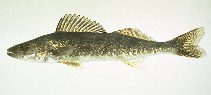
Duri punggung (Keseluruhan (total)) : 13 - 17; duri punggung lunak (Keseluruhan (total)) : 18 - 22; Duri dubur: 2; Sirip dubur lunak: 11 - 14; vertebrata, bertulang belakang: 44 - 48. Nuptial tubercles absent. Differentiation of sexes difficult. Branchiostegal rays 7,7 or 7,8 (Ref. 1998).
Body shape (shape guide): elongated; Cross section: compressed.
Adults occur in lakes, pools, backwaters, and runs of medium to large rivers. Frequently found in clear water, usually near brush (Ref. 86798). They prefer large, shallow lakes with high turbidity (Ref. 9988, 10294). Rarely found in brackish waters (Ref. 1998). They feed at night, mainly on insects and fishes (with preference for yellow perch and freshwater drum but will take any fish available) also feed on crayfish, snails, frogs, mudpuppies, and small mammals when fish and insects are scarce (Ref. 1998). Although not widely farmed commercially for consumption, large numbers are hatched and raised for stocking lakes for game fishing (Ref. 9988). Utilized fresh or frozen; eaten pan-fried, broiled, microwaved and baked (Ref. 9988).
Spawning occurs in small groups (a larger female and two smaller males or two females and up to six males) that engage in chasing, circular swimming, and fin erection. The group then ascends to shallow water, females roll on their side, and eggs and sperm are released. Deposition of eggs usually occurs in a single night (Ref. 1998). Larvae pelagic (Ref. 7471).
Page, L.M. and B.M. Burr, 2011. A field guide to freshwater fishes of North America north of Mexico. Boston : Houghton Mifflin Harcourt, 663p. (Ref. 86798)
Status IUCN Red List (Ref. 130435: Version 2025-2 (Global))
ancaman kepada manusia
Harmless
penggunaan manusia
Perikanan: komersial; Budidaya air: percobaan; Ikan buruan: ya; Akuarium: Akuarium publik
Alat, peralatan
laporan khas
muat turun XML
Sumber internet
Estimasi berdasarkan model
Indeks keanekaragaman filogenetik (Acuan
82804): PD
50 = 0.5312 [Uniqueness, from 0.5 = low to 2.0 = high].
Bayesian length-weight: a=0.00631 (0.00481 - 0.00827), b=3.15 (3.07 - 3.23), in cm total length, based on LWR estimates for this species (Ref.
93245).
Tingkat Trofik (Acuan
69278): 4.5 ±0.0 se; based on diet studies.
Generation time: 3.7 (3.0 - 3.8) years. Estimated as median ln(3)/K based on 42
growth studies.
Daya lenting (Acuan
120179): Rendah, Waktu penggandaan populasi minimum 4.5 - 14 tahun (K=0.05-0.45; tm=2-4; tmax=29; Fec=41,061).
Kerentanan Penangkapan Ikan (Ref.
59153): Moderate to high vulnerability (45 of 100).
🛈
Nutrisi (Ref.
124155): Calcium = 83.9 [34.8, 196.2] mg/100g; Iron = 0.483 [0.192, 1.201] mg/100g; Protein = 18.1 [16.9, 19.3] %; Omega3 = 0.17 [0.07, 0.35] g/100g; Selenium = 7.44 [1.82, 31.88] μg/100g; VitaminA = 18.6 [6.9, 51.0] μg/100g; Zinc = 0.913 [0.526, 1.539] mg/100g (wet weight); based on
nutrient studies.