>
Atheriniformes (Silversides) >
Atherinidae (Silversides) > Atherininae
Etymology: Atherina: Greek, atherina, the Greek name for the eperlane; 1770 (Ref. 45335).
Eponymy: Guillaume Boyer de Nice was a poet. The species was described in a book about the ichthyology of Nice. Risso chose to name the smelt after a historic son of that city; the poet who was a “…troubadour distingué du troisième siècle.” (Ref. 128868), visit book page.
More on author: Risso.
環境:環境 / 気候帯 / 深さの範囲 / 分布範囲
生態学
海; 新鮮な水; 汽水性の 底生の; 両側回遊性 (Ref. 59043); 深さの範囲 1 - ? m. Subtropical; 53°N - 20°N, 18°W - 42°E
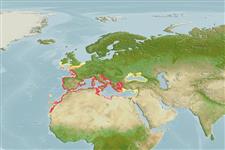
Eastern Atlantic: Portugal and Spain to Nouadhibou in Mauritania and Madeira, and throughout the Mediterranean and Black Sea. Isolated populations on coasts of England and the Netherlands (Ref. 5980). Previously, two subspecies were recognized in Russian waters: Atherina boyeri pontica (Eichwald, 1838) from the Black Sea and the Sea of Azov and Atherina boyeri caspia (Eichwald, 1838) from the Caspian Sea (Ref. 26334).
初回成熟時の長さ / サイズ / 重さ / 年齢
成熟: Lm 5.8, range 5 - ? cm
Max length : 20.0 cm TL オス/雌雄の選別がない; (Ref. 30578); 最大記録サイズ: 4 年 (Ref. 59043)
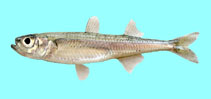
背面の脊椎 (合計) : 7 - 10; 背鰭 (合計) : 8 - 16; 肛門の骨: 2; 臀鰭: 10 - 18. Eye diameter wider than snout length (Ref. 35388).
Body shape (shape guide): elongated.
A very euryhaline species, where adults are frequently found in brackish waters and more sporadically in freshwater (Ref. 3788), preferring still or slow flowing waters in freshwater (Ref. 59043). They are found in lower parts of rivers, estuaries, coastal lakes and sea; pelagic in lakes (Ref. 59043). Adults occur in great schools. They are carnivorous, feeding on small crustaceans, worms, mollusks (Ref. 5980) and fish larvae (Ref. 35388) in lakes and estuaries, and on benthos in rivers (Ref. 59043). Can usually live 1 to 2 years, rarely up to 4 years. Some populations undergo spawning migrations into estuaries. Mature individuals are fractional spawners, larger individuals spawn for a longer period. Eggs are demersal, with long hairy appendages attaching them to the substrate consisting of filamentous algae, often at depths of 2 to 6 m. Larvae are pelagic often forming schools close to the shores (Ref. 59043).
ライフサイクルと交尾行動
成熟 | 繁殖 | 放精 | 卵 | 生産力 | 幼生
Maugé, L.A., 1990. Atherinidae. p. 604-605. In J.C. Quero, J.C. Hureau, C. Karrer, A. Post and L. Saldanha (eds.) Check-list of the fishes of the eastern tropical Atlantic (CLOFETA). JNICT, Lisbon; SEI, Paris; and UNESCO, Paris. Vol. 2. (Ref. 4499)
IUCNのレッドリストの状況は (Ref. 130435: Version 2025-2 (Global))
人間の用途
水産業: 商業
用具
特記事項
XMLをダウンロードして下さい
インターネットの情報源
モデルに基づく推定値
好ましい温度 (参照
123201): 13.9 - 21, mean 18.3 °C (based on 136 cells).
系統多様性指数 (参照
82804): PD
50 = 0.5312 [Uniqueness, from 0.5 = low to 2.0 = high].
Bayesian length-weight: a=0.00575 (0.00485 - 0.00683), b=3.07 (3.02 - 3.12), in cm total length, based on LWR estimates for this species (Ref.
93245).
栄養段階 (参照
69278): 3.2 ±0.36 se; based on food items.
回復力 (参照
120179): 手段, 1.4年~4.4年の倍増期間の最小個体群 (K=0.8; tm=1; tmax=4;).
Prior r = 0.57, 95% CL = 0.38 - 0.85, Based on 3 data-limited stock assessments.
漁業の脆弱性 (Ref.
59153): Moderate vulnerability (44 of 100).
🛈
気候脆弱性 (Ref.
125649): Moderate vulnerability (44 of 100).
🛈
栄養素 (Ref.
124155): Calcium = 134 [71, 293] mg/100g; Iron = 1.07 [0.63, 1.91] mg/100g; Protein = 20.4 [19.0, 21.6] %; Omega3 = 0.34 [0.18, 0.64] g/100g; Selenium = 14.4 [6.8, 32.4] μg/100g; VitaminA = 25.1 [8.8, 69.7] μg/100g; Zinc = 1.4 [0.9, 2.0] mg/100g (wet weight); based on
nutrient studies.