>
Atheriniformes (Silversides) >
Atherinidae (Silversides) > Atherininae
Etymology: Atherina: Greek, atherina, the Greek name for the eperlane; 1770 (Ref. 45335).
Eponymy: Guillaume Boyer de Nice was a poet. The species was described in a book about the ichthyology of Nice. Risso chose to name the smelt after a historic son of that city; the poet who was a “…troubadour distingué du troisième siècle.” (Ref. 128868), visit book page.
More on author: Risso.
Umwelt: Milieu / Klimazone / Tiefenbereich / Verbreitungsgebiet
Ökologie
seewasser; süßwasser; brackwasser demersal; amphidrom (Ref. 59043); tiefenbereich 1 - ? m. Subtropical; 53°N - 20°N, 18°W - 42°E
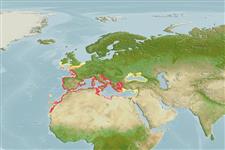
Eastern Atlantic: Portugal and Spain to Nouadhibou in Mauritania and Madeira, and throughout the Mediterranean and Black Sea. Isolated populations on coasts of England and the Netherlands (Ref. 5980). Previously, two subspecies were recognized in Russian waters: Atherina boyeri pontica (Eichwald, 1838) from the Black Sea and the Sea of Azov and Atherina boyeri caspia (Eichwald, 1838) from the Caspian Sea (Ref. 26334).
Länge bei der ersten Reifung / Größe / Gewicht / Alter
Geschlechtsreife: Lm 5.8, range 5 - ? cm
Max length : 20.0 cm TL Männchen/unbestimmt; (Ref. 30578); max. veröff. Alter: 4 Jahre (Ref. 59043)
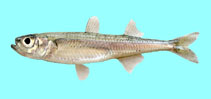
Rückenflossenstacheln (insgesamt) : 7 - 10; Rückenflossenweichstrahlen (insgesamt) : 8 - 16; Afterflossenstacheln: 2; Afterflossenweichstrahlen: 10 - 18. Eye diameter wider than snout length (Ref. 35388).
Body shape (shape guide): elongated.
A very euryhaline species, where adults are frequently found in brackish waters and more sporadically in freshwater (Ref. 3788), preferring still or slow flowing waters in freshwater (Ref. 59043). They are found in lower parts of rivers, estuaries, coastal lakes and sea; pelagic in lakes (Ref. 59043). Adults occur in great schools. They are carnivorous, feeding on small crustaceans, worms, mollusks (Ref. 5980) and fish larvae (Ref. 35388) in lakes and estuaries, and on benthos in rivers (Ref. 59043). Can usually live 1 to 2 years, rarely up to 4 years. Some populations undergo spawning migrations into estuaries. Mature individuals are fractional spawners, larger individuals spawn for a longer period. Eggs are demersal, with long hairy appendages attaching them to the substrate consisting of filamentous algae, often at depths of 2 to 6 m. Larvae are pelagic often forming schools close to the shores (Ref. 59043).
Maugé, L.A., 1990. Atherinidae. p. 604-605. In J.C. Quero, J.C. Hureau, C. Karrer, A. Post and L. Saldanha (eds.) Check-list of the fishes of the eastern tropical Atlantic (CLOFETA). JNICT, Lisbon; SEI, Paris; and UNESCO, Paris. Vol. 2. (Ref. 4499)
IUCN Rote Liste Status (Ref. 130435: Version 2025-2 (Global))
Bedrohung für Menschen
Harmless
Nutzung durch Menschen
Fischereien: kommerziell
Tools
Zusatzinformationen
Download XML
Internet Quellen
Schätzungen auf der Grundlage von Modellen
Bevorzugte Temperatur (Ref.
123201): 13.9 - 21, mean 18.3 °C (based on 136 cells).
Phylogenetischer Diversitätsindex (Ref.
82804): PD
50 = 0.5312 [Uniqueness, from 0.5 = low to 2.0 = high].
Bayesian length-weight: a=0.00575 (0.00485 - 0.00683), b=3.07 (3.02 - 3.12), in cm total length, based on LWR estimates for this species (Ref.
93245).
Trophische Ebene (Ref.
69278): 3.2 ±0.36 se; based on food items.
Widerstandsfähigkeit (Ref.
120179): mittel, Verdopplung der Population dauert 1,4 - 4,4 Jahre. (K=0.8; tm=1; tmax=4;).
Prior r = 0.57, 95% CL = 0.38 - 0.85, Based on 3 data-limited stock assessments.
Anfälligkeit der Fischerei (Ref.
59153): Moderate vulnerability (44 of 100).
🛈
Klimaanfälligkeit (Ref.
125649): Moderate vulnerability (44 of 100).
🛈
Nährstoffe (Ref.
124155): Calcium = 134 [71, 293] mg/100g; Iron = 1.07 [0.63, 1.91] mg/100g; Protein = 20.4 [19.0, 21.6] %; Omega3 = 0.34 [0.18, 0.64] g/100g; Selenium = 14.4 [6.8, 32.4] μg/100g; VitaminA = 25.1 [8.8, 69.7] μg/100g; Zinc = 1.4 [0.9, 2.0] mg/100g (wet weight); based on
nutrient studies.