>
Clupeiformes (Herrings) >
Dorosomatidae (Gizzard shads and sardinellas)
Etymology: Sardinella: Latin and Greek, sarda = sardine; name related to the island of Sardinia; diminutive (Ref. 45335).
More on author: Valenciennes.
Entorno: milieu / zona climática / rango de profundidad / gama de distribución
Ecología
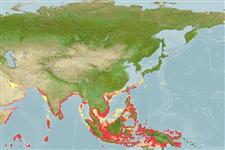
marino; salobre pelagic-neritic; rango de profundidad 0 - 50 m (Ref. 188). Tropical; 30°N - 11°S, 47°E - 153°E (Ref. 188)
Indo-West Pacific: from Kuwait to southern India and Bay of Bengal to the Philippines, also eastern tip of Papua New Guinea. Often confused with Sardinella gibbosa in Indian waters.
Longitud en la primera madurez / Tamaño / Peso / Edad
Madurez: Lm 12.3, range 10 - ? cm
Max length : 19.0 cm TL macho / no sexado; (Ref. 2178); common length : 11.0 cm SL macho / no sexado; (Ref. 188)
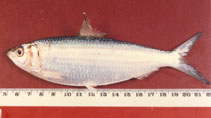
Espinas dorsales (total) : 0; Radios blandos dorsales (total) : 18 - 19; Espinas anales: 0; Radios blandos anales: 18 - 20. This species is distinguished by the following characters: deep body, its depth 28·0-33·2% SL; interrupted longitudinal striae formation in lateral scales; scutes prepelvic and post-pelvic 17-18 + 11-12, respectively, oftern 18 + 12; A 18-20 rays, usually 19; lower gill rakers 65-81 (Ref. 114969).
Body shape (shape guide): fusiform / normal; Cross section: compressed.
Forms schools in coastal waters. Misidentifications (especially with S. gibbosa in Indian waters and S. albella in the western Indian Ocean) make published biological data potentially unreliable. Marketed fresh, dried-salted, boiled or made into fish balls.
Whitehead, P.J.P., 1985. FAO Species Catalogue. Vol. 7. Clupeoid fishes of the world (suborder Clupeoidei). An annotated and illustrated catalogue of the herrings, sardines, pilchards, sprats, shads, anchovies and wolf-herrings. FAO Fish. Synop. 125(7/1):1-303. Rome: FAO. (Ref. 188)
Situación en la Lista Roja de la UICN (Ref. 130435: Version 2025-2 (Global))
Amenaza para el ser humano
Harmless
Usos humanos
Pesquerías: comercial
Herramientas
Informes especiales
Descargar XML
Fuentes de Internet
Estimaciones basadas en modelos
Temperatura preferida (Referencia
123201): 27.5 - 29.2, mean 28.6 °C (based on 862 cells).
Índice de diversidad filogenética (Referencia
82804): PD
50 = 0.5000 [Uniqueness, from 0.5 = low to 2.0 = high].
Bayesian length-weight: a=0.00741 (0.00615 - 0.00893), b=3.04 (3.01 - 3.07), in cm total length, based on LWR estimates for this species (Ref.
93245).
Nivel trófico (Referencia
69278): 3.2 ±0.34 se; based on food items.
Generation time: 1.1 (0.9 - 1.2) years. Estimated as median ln(3)/K based on 19
growth studies.
Resiliencia (Referencia
120179): Alto, población duplicada en un tiempo mínimo inferior a 15 meses (K=0.7-1.6; tmax=3).
Prior r = 0.84, 95% CL = 0.56 - 1.26, Based on 1 data-limited stock assessment.
Vulnerabilidad pesquera (Ref.
59153): Low vulnerability (10 of 100).
🛈
Vulnerabilidad climática (Ref.
125649): Moderate to high vulnerability (53 of 100).
🛈
Nutrientes (Ref.
124155): Calcium = 426 [251, 679] mg/100g; Iron = 2.7 [1.7, 4.3] mg/100g; Protein = 20.6 [19.7, 21.5] %; Omega3 = 0.318 [0.165, 0.607] g/100g; Selenium = 106 [55, 204] μg/100g; VitaminA = 19.9 [8.0, 50.8] μg/100g; Zinc = 2.01 [1.49, 2.67] mg/100g (wet weight); based on
nutrient studies.