>
Clupeiformes (Herrings) >
Dorosomatidae (Gizzard shads and sardinellas)
Etymology: Sardinella: Latin and Greek, sarda = sardine; name related to the island of Sardinia; diminutive (Ref. 45335).
More on author: Steindachner.
Umwelt: Milieu / Klimazone / Tiefenbereich / Verbreitungsgebiet
Ökologie
seewasser; brackwasser pelagic-neritic; ozeanodrom; tiefenbereich 5 - 60 m (Ref. 114041). Subtropical; 31°N - 36°S, 98°W - 35°W
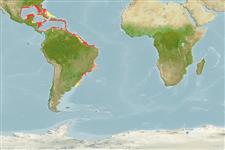
Western Atlantic: Gulf of Mexico, Caribbean, West Indies southward to Brazil and northern Uruguay (identifications are not always reliable).
Länge bei der ersten Reifung / Größe / Gewicht / Alter
Geschlechtsreife: Lm 19.2 range ? - ? cm
Max length : 27.0 cm TL Männchen/unbestimmt; (Ref. 103182); common length : 20.0 cm SL Männchen/unbestimmt; (Ref. 188)
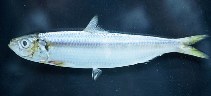
Rückenflossenstacheln (insgesamt) : 0; Rückenflossenweichstrahlen (insgesamt) : 13 - 21; Afterflossenstacheln: 0; Afterflossenweichstrahlen: 12 - 23. Diagnostic features as for Sardinella aurita from which it differs in having the anterior gill rakers on the lower limbs of the second and third gill arches distinctly curled downward (more or less flat in S. aurita) (Ref. 188). The pelvic fin ray count of i 8 distinguishes S. brasiliensis from all other species of Sardinella, also Harengula and Opisthonema (Ref. 188). Similar to S. aurita (Ref. 26938). Bluish black above. Peritoneum black (Ref. 37032). Separation of Sardinella brasiliensis (synonym of Sardinella janeiro) from Sardinella aurita on the basis of gill raker shape and a higher gill raker count is tentative.
Body shape (shape guide): fusiform / normal; Cross section: compressed.
Found in coastal waters, often forming compact schools. Maximum depth range based on spawners in Brazil (Ref. 114041). Probably similar to S. aurita, but if they are indeed distinct, then this species may account for the double spawning peaks of S. aurita. Constitutes a large fishery in Venezuela, but statistical reports are not separated from S. aurita. Marketed fresh and canned (Ref. 5217).
Whitehead, P.J.P., 1985. FAO Species Catalogue. Vol. 7. Clupeoid fishes of the world (suborder Clupeoidei). An annotated and illustrated catalogue of the herrings, sardines, pilchards, sprats, shads, anchovies and wolf-herrings. FAO Fish. Synop. 125(7/1):1-303. Rome: FAO. (Ref. 188)
IUCN Rote Liste Status (Ref. 130435: Version 2025-2 (Global))
Bedrohung für Menschen
Harmless
Nutzung durch Menschen
Fischereien: hoch kommerziell; Köder: usually
Tools
Zusatzinformationen
Download XML
Internet Quellen
Schätzungen auf der Grundlage von Modellen
Bevorzugte Temperatur (Ref.
123201): 22.7 - 28, mean 26 °C (based on 290 cells).
Phylogenetischer Diversitätsindex (Ref.
82804): PD
50 = 0.5000 [Uniqueness, from 0.5 = low to 2.0 = high].
Bayesian length-weight: a=0.00759 (0.00639 - 0.00900), b=3.05 (3.02 - 3.08), in cm total length, based on LWR estimates for this species (Ref.
93245).
Trophische Ebene (Ref.
69278): 3.1 ±0.30 se; based on food items.
Widerstandsfähigkeit (Ref.
120179): hoch, Verdopplung der Population dauert weniger als 15 Monate. (K=0.44-0.72; tm=1).
Prior r = 0.40, 95% CL = 0.26 - 0.60, Based on 1 data-limited stock assessment.
Anfälligkeit der Fischerei (Ref.
59153): Low vulnerability (23 of 100).
🛈
Klimaanfälligkeit (Ref.
125649): Low vulnerability (11 of 100).
🛈
Nährstoffe (Ref.
124155): Calcium = 141 [78, 222] mg/100g; Iron = 1.98 [1.21, 3.20] mg/100g; Protein = 21.3 [20.4, 22.2] %; Omega3 = 0.456 [0.234, 0.849] g/100g; Selenium = 41.7 [21.8, 80.6] μg/100g; VitaminA = 22.8 [7.3, 71.3] μg/100g; Zinc = 0.804 [0.591, 1.190] mg/100g (wet weight);