>
Clupeiformes (Herrings) >
Dorosomatidae (Gizzard shads and sardinellas)
Etymology: Sardinella: Latin and Greek, sarda = sardine; name related to the island of Sardinia; diminutive (Ref. 45335).
More on author: Steindachner.
Lingkungan: lingkungan / zona iklim / kisaran kedalaman / jangkauan distribusi
Ekologi
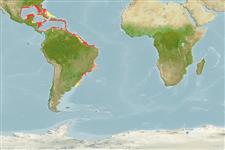
laut; payau pelagic-neritic; oceanodromus; kisaran kedalaman 5 - 60 m (Ref. 114041). Subtropical; 31°N - 36°S, 98°W - 35°W
Western Atlantic: Gulf of Mexico, Caribbean, West Indies southward to Brazil and northern Uruguay (identifications are not always reliable).
Panjang pada saat jatuh tempo pertama / Ukuran / Berat / umur
Kematangan: Lm 19.2 range ? - ? cm
Max length : 27.0 cm TL jantan/; (Ref. 103182); common length : 20.0 cm SL jantan/; (Ref. 188)
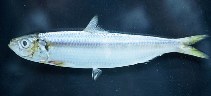
Duri punggung (Keseluruhan (total)) : 0; duri punggung lunak (Keseluruhan (total)) : 13 - 21; Duri dubur: 0; Sirip dubur lunak: 12 - 23. Diagnostic features as for Sardinella aurita from which it differs in having the anterior gill rakers on the lower limbs of the second and third gill arches distinctly curled downward (more or less flat in S. aurita) (Ref. 188). The pelvic fin ray count of i 8 distinguishes S. brasiliensis from all other species of Sardinella, also Harengula and Opisthonema (Ref. 188). Similar to S. aurita (Ref. 26938). Bluish black above. Peritoneum black (Ref. 37032). Separation of Sardinella brasiliensis (synonym of Sardinella janeiro) from Sardinella aurita on the basis of gill raker shape and a higher gill raker count is tentative.
Body shape (shape guide): fusiform / normal; Cross section: compressed.
Found in coastal waters, often forming compact schools. Maximum depth range based on spawners in Brazil (Ref. 114041). Probably similar to S. aurita, but if they are indeed distinct, then this species may account for the double spawning peaks of S. aurita. Constitutes a large fishery in Venezuela, but statistical reports are not separated from S. aurita. Marketed fresh and canned (Ref. 5217).
Siklus hidup dan perilaku kawin
Kematangan | Reproduksi, perkembang biakan | Pemijahan | telur-telur | Fekunditas | Larva
Whitehead, P.J.P., 1985. FAO Species Catalogue. Vol. 7. Clupeoid fishes of the world (suborder Clupeoidei). An annotated and illustrated catalogue of the herrings, sardines, pilchards, sprats, shads, anchovies and wolf-herrings. FAO Fish. Synop. 125(7/1):1-303. Rome: FAO. (Ref. 188)
Status IUCN Red List (Ref. 130435: Version 2025-2 (Global))
ancaman kepada manusia
Harmless
penggunaan manusia
Perikanan: bernilai komersial tinggi; umpan: usually
Alat, peralatan
laporan khas
muat turun XML
Sumber internet
Estimasi berdasarkan model
Suhu yang disukai (Acuan
123201): 22.7 - 28, mean 26 °C (based on 290 cells).
Indeks keanekaragaman filogenetik (Acuan
82804): PD
50 = 0.5000 [Uniqueness, from 0.5 = low to 2.0 = high].
Bayesian length-weight: a=0.00759 (0.00639 - 0.00900), b=3.05 (3.02 - 3.08), in cm total length, based on LWR estimates for this species (Ref.
93245).
Tingkat Trofik (Acuan
69278): 3.1 ±0.30 se; based on food items.
Daya lenting (Acuan
120179): Tinggi, Waktu penggandaan populasi minimum kurang dari 15 bulan (K=0.44-0.72; tm=1).
Prior r = 0.40, 95% CL = 0.26 - 0.60, Based on 1 data-limited stock assessment.
Kerentanan Penangkapan Ikan (Ref.
59153): Low vulnerability (23 of 100).
🛈
Kerentanan Iklim (Ref.
125649): Low vulnerability (11 of 100).
🛈
Nutrisi (Ref.
124155): Calcium = 141 [78, 222] mg/100g; Iron = 1.98 [1.21, 3.20] mg/100g; Protein = 21.3 [20.4, 22.2] %; Omega3 = 0.456 [0.234, 0.849] g/100g; Selenium = 41.7 [21.8, 80.6] μg/100g; VitaminA = 22.8 [7.3, 71.3] μg/100g; Zinc = 0.804 [0.591, 1.190] mg/100g (wet weight);