>
Clupeiformes (Herrings) >
Dorosomatidae (Gizzard shads and sardinellas)
Etymology: Sardinella: Latin and Greek, sarda = sardine; name related to the island of Sardinia; diminutive (Ref. 45335).
More on author: Steindachner.
Environnement : milieu / zone climatique / profondeur / gamme de distribution
Écologie
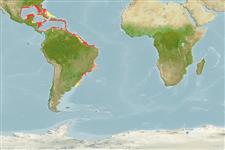
marin; saumâtre pelagic-neritic; océanodrome; profondeur 5 - 60 m (Ref. 114041). Subtropical; 31°N - 36°S, 98°W - 35°W
Western Atlantic: Gulf of Mexico, Caribbean, West Indies southward to Brazil and northern Uruguay (identifications are not always reliable).
Longueur à la première maturité / Taille / Poids / Âge
Maturité: Lm 19.2 range ? - ? cm
Max length : 27.0 cm TL mâle / non sexé; (Ref. 103182); common length : 20.0 cm SL mâle / non sexé; (Ref. 188)
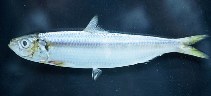
Épines dorsales (Total) : 0; Rayons mous dorsaux (Total) : 13 - 21; Épines anales: 0; Rayons mous anaux: 12 - 23. Diagnostic features as for Sardinella aurita from which it differs in having the anterior gill rakers on the lower limbs of the second and third gill arches distinctly curled downward (more or less flat in S. aurita) (Ref. 188). The pelvic fin ray count of i 8 distinguishes S. brasiliensis from all other species of Sardinella, also Harengula and Opisthonema (Ref. 188). Similar to S. aurita (Ref. 26938). Bluish black above. Peritoneum black (Ref. 37032). Separation of Sardinella brasiliensis (synonym of Sardinella janeiro) from Sardinella aurita on the basis of gill raker shape and a higher gill raker count is tentative.
Body shape (shape guide): fusiform / normal; Cross section: compressed.
Found in coastal waters, often forming compact schools. Maximum depth range based on spawners in Brazil (Ref. 114041). Probably similar to S. aurita, but if they are indeed distinct, then this species may account for the double spawning peaks of S. aurita. Constitutes a large fishery in Venezuela, but statistical reports are not separated from S. aurita. Marketed fresh and canned (Ref. 5217).
Cycle de vie et comportement reproducteur
Maturité | Reproduction | Frai | Œufs | Fécondité | Larves
Whitehead, P.J.P., 1985. FAO Species Catalogue. Vol. 7. Clupeoid fishes of the world (suborder Clupeoidei). An annotated and illustrated catalogue of the herrings, sardines, pilchards, sprats, shads, anchovies and wolf-herrings. FAO Fish. Synop. 125(7/1):1-303. Rome: FAO. (Ref. 188)
Statut dans la liste rouge de l'IUCN (Ref. 130435: Version 2025-2 (Global))
Menace pour l'homme
Harmless
Utilisations par l'homme
Pêcheries: hautement commercial; appât: usually
Outils
Articles particuliers
Télécharger en XML
Sources Internet
Estimations basées sur des modèles
Température préférée (Réf.
123201): 22.7 - 28, mean 26 °C (based on 290 cells).
Indice de diversité phylogénétique (Réf.
82804): PD
50 = 0.5000 [Uniqueness, from 0.5 = low to 2.0 = high].
Bayesian length-weight: a=0.00759 (0.00639 - 0.00900), b=3.05 (3.02 - 3.08), in cm total length, based on LWR estimates for this species (Ref.
93245).
Niveau trophique (Réf.
69278): 3.1 ±0.30 se; based on food items.
Résilience (Réf.
120179): Haut, temps minimum de doublement de population inférieur à 15 mois (K=0.44-0.72; tm=1).
Prior r = 0.40, 95% CL = 0.26 - 0.60, Based on 1 data-limited stock assessment.
Vulnérabilité de la pêche (Ref.
59153): Low vulnerability (23 of 100).
🛈
Vulnérabilité climatique (Ref.
125649): Low vulnerability (11 of 100).
🛈
Nutriments (Ref.
124155): Calcium = 141 [78, 222] mg/100g; Iron = 1.98 [1.21, 3.20] mg/100g; Protein = 21.3 [20.4, 22.2] %; Omega3 = 0.456 [0.234, 0.849] g/100g; Selenium = 41.7 [21.8, 80.6] μg/100g; VitaminA = 22.8 [7.3, 71.3] μg/100g; Zinc = 0.804 [0.591, 1.190] mg/100g (wet weight);