>
Clupeiformes (Herrings) >
Dorosomatidae (Gizzard shads and sardinellas)
Etymology: Harengula: Old English haring, hering = mackerel, the fish Clupea harengus (Ref. 45335).
More on author: Cuvier.
Окружающая среда: среда / климатическая зона / пределы глубины / диапазон распространения
экология
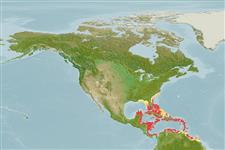
морской ассоциированный с рифами; пределы глубины 0 - 50 m (Ref. 188). Subtropical; 34°N - 4°N, 90°W - 52°W (Ref. 188)
Western Atlantic: Bermuda, Florida (USA), Bahamas, Caribbean, Guianas (but no records to the south of this; no Brazilian specimens in the extensive collections of the Museu de Zoologia, Sao Paulo, Brazil).
Длина при первой зрелости / Размер / Вес / Возраст
половая зрелость: Lm 11.0, range 9 - ? cm
Max length : 22.0 cm TL самец/пол неопределен; (Ref. 26340); common length : 15.0 cm TL самец/пол неопределен; (Ref. 5217)
колючие лучи спинного плавника (общее число) : 0; членистые (мягкие) лучи спинного плавника (общее число) : 13 - 21; колючие лучи анального плавника: 0; членистые (мягкие) лучи анального плавника: 12 - 23. Tooth plate on tongue and tooth plate behind it (basihyal and basibranchial tooth plates) very narrow, their width about 10 times in combined length, the basihyal tooth plate not bulging in front. Scales thin, loosely attached, easily shed. Tips of anterior dorsal fin rays dark. Reddish or orange spot behind upper end of gill (Ref. 26938). Body slender, with evenly curved upper and lower profiles (Ref. 7251).
Body shape (shape guide): fusiform / normal; Cross section: compressed.
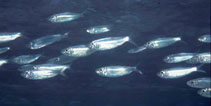
Occur in coastal waters, usually along the shoreline (Ref. 9710) and over clear coral reefs (Ref. 5217). May form large schools in beaches, mainly over Thalassia beds (Ref. 5217). Often in polluted areas (Ref. 9710).
Жизненный цикл и брачное поведение
половая зрелость | размножение | нерест | икра | Плодовитость | личинки
Whitehead, P.J.P., 1985. FAO Species Catalogue. Vol. 7. Clupeoid fishes of the world (suborder Clupeoidei). An annotated and illustrated catalogue of the herrings, sardines, pilchards, sprats, shads, anchovies and wolf-herrings. FAO Fish. Synop. 125(7/1):1-303. Rome: FAO. (Ref. 188)
Статус Красного Списка МСОП (Ref. 130435: Version 2025-2 (Global))
Использование человеком
рыболовство: коммерческий; наживка: usually
дополнительная информация
инструменты
Специальные отчеты
Скачать в формате XML
ресурсы в Интернет
Оценки, основанные на моделях
Предпочтительная температура (ссылка
123201): 24.5 - 28, mean 26.7 °C (based on 104 cells).
Индекс филогенетического разнообразия (ссылка
82804): PD
50 = 0.5625 [Uniqueness, from 0.5 = low to 2.0 = high].
Bayesian length-weight: a=0.01000 (0.00645 - 0.01551), b=3.09 (2.96 - 3.22), in cm total length, based on LWR estimates for this species & (Sub)family-body (Ref.
93245).
Трофический уровень (ссылка
69278): 3.4 ±0.1 se; based on diet studies.
Generation time: 2.7 ( na - na) years. Estimated as median ln(3)/K based on 2
growth studies.
устойчивость к внешним воздействиям (ссылка
120179): высокий, минимальное время удвоения популяции до 15 месяцев (K=0.41-1.03; tm=1.5; Fec=41,000).
Уязвимость рыбной ловли (Ref.
59153): Low vulnerability (14 of 100).
🛈
Питательные вещества (Ref.
124155): Calcium = 61.6 [28.5, 116.2] mg/100g; Iron = 1.07 [0.53, 1.98] mg/100g; Protein = 20 [19, 21] %; Omega3 = 0.348 [0.190, 0.650] g/100g; Selenium = 17.1 [8.4, 38.4] μg/100g; VitaminA = 53.8 [17.1, 175.0] μg/100g; Zinc = 0.913 [0.586, 1.427] mg/100g (wet weight);