>
Clupeiformes (Herrings) >
Dorosomatidae (Gizzard shads and sardinellas)
Etymology: Harengula: Old English haring, hering = mackerel, the fish Clupea harengus (Ref. 45335).
More on author: Cuvier.
Milieu: milieu / Klimaatzone / Diepte / verspreidingsgebied
Ecologie
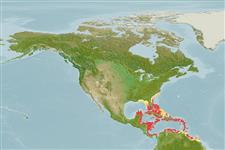
marien rifbewoner; diepte 0 - 50 m (Ref. 188). Subtropical; 34°N - 4°N, 90°W - 52°W (Ref. 188)
Western Atlantic: Bermuda, Florida (USA), Bahamas, Caribbean, Guianas (but no records to the south of this; no Brazilian specimens in the extensive collections of the Museu de Zoologia, Sao Paulo, Brazil).
Lengte bij maturiteit / Grootte / Gewicht / Leeftijd
Maturiteit: Lm 11.0, range 9 - ? cm
Max length : 22.0 cm TL mannelijk / geslacht onbekend; (Ref. 26340); common length : 15.0 cm TL mannelijk / geslacht onbekend; (Ref. 5217)
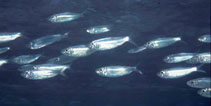
Dorsale stekels (totaal) : 0; Dorsale zachte stralen (totaal) : 13 - 21; Anale stekels: 0; Anale zachte stralen: 12 - 23. Tooth plate on tongue and tooth plate behind it (basihyal and basibranchial tooth plates) very narrow, their width about 10 times in combined length, the basihyal tooth plate not bulging in front. Scales thin, loosely attached, easily shed. Tips of anterior dorsal fin rays dark. Reddish or orange spot behind upper end of gill (Ref. 26938). Body slender, with evenly curved upper and lower profiles (Ref. 7251).
Body shape (shape guide): fusiform / normal; Cross section: compressed.
Occur in coastal waters, usually along the shoreline (Ref. 9710) and over clear coral reefs (Ref. 5217). May form large schools in beaches, mainly over Thalassia beds (Ref. 5217). Often in polluted areas (Ref. 9710).
Levenscyclus en paargedrag
Maturiteit | Voortplanting | Paaien | Eieren | Fecunditeit | Larven
Whitehead, P.J.P., 1985. FAO Species Catalogue. Vol. 7. Clupeoid fishes of the world (suborder Clupeoidei). An annotated and illustrated catalogue of the herrings, sardines, pilchards, sprats, shads, anchovies and wolf-herrings. FAO Fish. Synop. 125(7/1):1-303. Rome: FAO. (Ref. 188)
Status op de Rode Lijst van het IUCN (Ref. 130435: Version 2025-2 (Global))
Gebruik door de mens
Visserij: commercieel; aas: usually
Tools
Speciale rapporten
Download XML
Internetbronnen
Schattingen op basis van modellen
Gewenste temperatuur (Ref.
123201): 24.5 - 28, mean 26.7 °C (based on 104 cells).
Fylogenetische diversiteitsindex (Ref.
82804): PD
50 = 0.5625 [Uniqueness, from 0.5 = low to 2.0 = high].
Bayesian length-weight: a=0.01000 (0.00645 - 0.01551), b=3.09 (2.96 - 3.22), in cm total length, based on LWR estimates for this species & (Sub)family-body (Ref.
93245).
Trofisch niveau (Ref.
69278): 3.4 ±0.1 se; based on diet studies.
Generation time: 2.7 ( na - na) years. Estimated as median ln(3)/K based on 2
growth studies.
Weerstandsvermogen (Ref.
120179): Hoog, minimale populatieverdubbelingstijd minder dan 15 maanden (K=0.41-1.03; tm=1.5; Fec=41,000).
Kwetsbaarheid van de visserij (Ref.
59153): Low vulnerability (14 of 100).
🛈
Voedingsstoffen (Ref.
124155): Calcium = 61.6 [28.5, 116.2] mg/100g; Iron = 1.07 [0.53, 1.98] mg/100g; Protein = 20 [19, 21] %; Omega3 = 0.348 [0.190, 0.650] g/100g; Selenium = 17.1 [8.4, 38.4] μg/100g; VitaminA = 53.8 [17.1, 175.0] μg/100g; Zinc = 0.913 [0.586, 1.427] mg/100g (wet weight);