>
Clupeiformes (Herrings) >
Dorosomatidae (Gizzard shads and sardinellas)
Etymology: Harengula: Old English haring, hering = mackerel, the fish Clupea harengus (Ref. 45335).
More on author: Cuvier.
Περιβάλλον: περιβάλλον / κλιματική ζώνη / εύρος βάθους / εύρος διανομής
Οικολογία
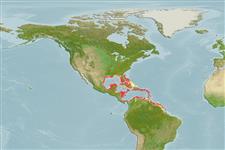
Θαλασσινό(ά); Υφάλμυρο Υφαλόφιλο(α); εύρος βάθους 0 - 50 m (Ref. 188). Subtropical; 31°N - 7°S, 99°W - 47°W (Ref. 188)
Western Atlantic: Gulf of Mexico and southeastern Florida to northern Brazil, including the Bahamas, the entire Caribbean and the West Indies.
Μήκος κατά την πρώτη ωρίμανση / Μέγεθος / Βάρος / Ηλικία
Γεννητική Ωρίμανση: Lm ?, range 7 - ? cm
Max length : 31.3 cm SL αρσενικό/απροσδιόριστο; (Ref. 137577); common length : 10.0 cm SL αρσενικό/απροσδιόριστο; (Ref. 188); μεγ. δημοσιευμένο βάρος: 109.00 g (Ref. 126891)
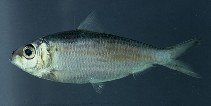
Ραχιαίες άκανθες (συνολικά) : 0; Μαλακές ραχιαίες ακτίνες (συνολικά) : 15 - 21; Εδρικές άκανθες: 0; Μαλακές εδρικές ακτίνες: 12 - 23. Tooth-plate on tongue and tooth plate behind it (basihyal and basibranchials tooth plates) broad, their width about 3 to 5 times in their combined length, the basibranchial tooth plate with a distinct bulge in front. Scales fairly strongly attached, not easily lost. No dark pigment on dorsal fin tip (Ref. 188). Silvery, with a dark greenish back. Diffuse yellow or pale orange spot at edge of opercle. Body slender, lower profile not strongly curved (Ref. 7251).
Body shape (shape guide): fusiform / normal; Cross section: compressed.
Occurs in coastal waters, estuaries and lagoons, tolerating low salinities. Can tolerate a broad range of salinity levels (Ref. 26938). Forms schools, small individuals often along sandy beaches. Its flesh has an unpleasant odor. Utilized as fishmeal (Ref. 5217).
Κύκλος ζωής και συμπεριφορά ζευγαρώματος
Γεννητική Ωρίμανση | Αναπαραγωγή | Γεννοβολία | Αβγά | Γονιμότητα | Προνύμφες
Whitehead, P.J.P., 1985. FAO Species Catalogue. Vol. 7. Clupeoid fishes of the world (suborder Clupeoidei). An annotated and illustrated catalogue of the herrings, sardines, pilchards, sprats, shads, anchovies and wolf-herrings. FAO Fish. Synop. 125(7/1):1-303. Rome: FAO. (Ref. 188)
Κατάσταση Κόκκινου Καταλόγου IUCN (Ref. 130435: Version 2025-2 (Global))
Απειλή για τον άνθρωπο
Harmless
Ανθρώπινες χρήσεις
αλιεία: περιορισμένης εμπορικότητας; δόλωμα: usually
Εργαλεία
Ειδικές εκθέσεις
Λήψη XML
Διαδικτυακές πηγές
Εκτιμήσεις βάσει μοντέλων
Προτιμώμενη θερμοκρασία (Αναφ.
123201): 24.3 - 28, mean 26.8 °C (based on 230 cells).
Δείκτης φυλογενετικής ποικιλότητας (Αναφ.
82804): PD
50 = 0.5625 [Uniqueness, from 0.5 = low to 2.0 = high].
Bayesian length-weight: a=0.00851 (0.00760 - 0.00953), b=3.07 (3.04 - 3.10), in cm total length, based on LWR estimates for this species (Ref.
93245).
Τροφικό Επίπεδο (Αναφ.
69278): 3.3 ±0.3 se; based on diet studies.
Generation time: 2.6 ( na - na) years. Estimated as median ln(3)/K based on 1
growth studies.
Ελαστικότητα (Αναφ.
120179): Υψηλό, ελάχιστος χρόνος για διπλασιασμό πληθυσμού < 15 μήνες (Preliminary K or Fecundity.).
Ευπάθεια στην αλιεία (Ref.
59153): Low to moderate vulnerability (29 of 100).
🛈
Θρεπτικά συστατικά (Ref.
124155): Calcium = 64.6 [30.1, 127.7] mg/100g; Iron = 1.01 [0.50, 1.87] mg/100g; Protein = 20.1 [18.8, 21.4] %; Omega3 = 0.39 [0.21, 0.71] g/100g; Selenium = 14.5 [6.7, 31.4] μg/100g; VitaminA = 65.7 [20.2, 208.6] μg/100g; Zinc = 1.1 [0.7, 1.8] mg/100g (wet weight);