>
Centrarchiformes (Basses) >
Latridae (Trumpeters)
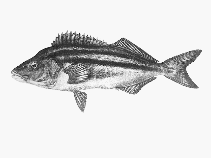
Etymology: Latris: Greek, latris = slave (Ref. 45335); lineata: Named for the on the distinctive dark lines running longitudinally across the body.
More on author: Forster.
Ambiente: milieu / zona climatica / distribuzione batimetrica / gamma di distribuzione
Ecologia
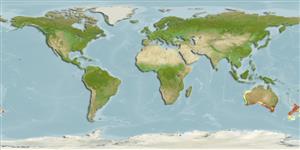
marino associati a barriera corallina; distribuzione batimetrica 5 - 400 m (Ref. 76767). Temperate; 17°S - 56°S, 13°W - 175°W
Southern Hemisphere: Atlantic Ocean (from Tristan da Cunha and Gough I.); Indian Ocean (Walter Shoals and Saint Paul's I. and Amsterdam Is., Western Australia, across South Australia to southern New South Wales and Tasmania; Pacific Ocean (New Zealand, Bay of Plenty, east to the Chatham Is, and south to the Snares Is. and the subantarctic Auckland Is.). Latris hecateia has been listed in Chile, but records are questionable (Ref. 76767).
Lunghezza alla prima maturità / Dimensione / Peso / Età
Maturità: Lm 54.3, range 51 - ? cm
Max length : 120 cm TL maschio/sesso non determinato; (Ref. 9563); peso massimo pubblicato: 25.0 kg (Ref. 26433); Età massima riportata: 43 anni (Ref. 53584)
Breve descrizione
Chiavi di identificazione | Morfologia | Morfometria
Spine dorsali (totale) : 17 - 19; Raggi dorsali molli (totale) : 33 - 38; Spine anali: 3; Raggi anali molli: 26 - 30; Vertebre: 37. This species can be distinguished from all other latrids and cheilodactylids (and most percoids) by having anal fin soft rays 26-30; vertebrae 16+21 = 37; a striped body colour pattern comprising three dark bands running longitudinally on the upper body and onto the opercular series and head, with a broader faint band on the flank and a narrow dorsal median band running along the nape and head in front of the dorsal fin (Ref. 76767).
Body shape (shape guide): fusiform / normal.
Adults apparently prefer broken rocky reefs, rich in 'coral' and other invertebrate life. Reported to be frequently found over rocky places, especially narrow channels between two cliffs in fjords of New Zealand. May spawn closer to shore (Ref. 9563) but probably in areas of deeper waters, otherwise they seem to migrate offshore to spawn (Ref. 85801). Collected by bottom trawls, dropline, and rod and line (Ref. 76767). In Australia, adults are found over rocky reefs at depths from 5 to 300 m (Ref. 53584).
Females are multiple spawners with group synchronous oocyte development (Ref. 95206).
Roberts, C.D., 2003. A new species of trumpeter (Teleostei; Percomorpha; Latridae) from the central South Pacific Ocean, with a taxonomic review of the striped trumpeter Latris lineata. J. R. Soc. N. Z. 33(4):731-754. (Ref. 76767)
Stato della Lista Rossa IUCN (Ref. 130435: Version 2025-2 (Global))
Minaccia per l'uomo
Harmless
Usi umani
Pesca: commerciale; Acquacoltura: sperimentale
Strumenti
Rapporti speciali
Scarica XML
Fonti Internet
Stime basate su modelli
Temperatura preferita (Fonte Biblio.
123201): 10.6 - 21.2, mean 14.9 °C (based on 181 cells).
Indice di diversità filogenetica (Fonte Biblio.
82804): PD
50 = 0.7500 [Uniqueness, from 0.5 = low to 2.0 = high].
Bayesian length-weight: a=0.01349 (0.00825 - 0.02206), b=3.06 (2.91 - 3.21), in cm total length, based on LWR estimates for this species & (Sub)family-body (Ref.
93245).
Livello trofico (Fonte Biblio.
69278): 3.5 ±0.2 se; based on size and trophs of closest relatives
Generation time: 15.8 ( na - na) years. Estimated as median ln(3)/K based on 2
growth studies.
Resilienza (Fonte Biblio.
120179): Molto basso, tempo minimo di raddoppiamento della popolazione più di 14 anni (K=0.06-0.4; tmax=43; tm=5-7; Fec=205,054 (batch)).
Vulnerabilità della pesca (Ref.
59153): High to very high vulnerability (67 of 100).
🛈