Lớp phụ Cá sụn (cá mập và cá đuối) (sharks and rays) >
Myliobatiformes (Stingrays) >
Dasyatidae (Stingrays) > Urogymninae
Etymology: Brevitrygon: Name from Latin 'brevis' meaning short and 'trygṓn' meaning stingray, referring to the short, semi-rigid tails of these stingrays; imbricata: Name fro Latin 'imbricata' meaning overlapping each other, referring to the secondary denticle band, which is very narrow over the branchial region and abdomen in this species.
More on authors: Bloch & Schneider.
Môi trường: môi trường / vùng khí hậu / Mức độ sâu / phạm vi phân phối
Sinh thái học
biển; nước ngọt; thuộc về nước lợ gần đáy; sống cả ở nước ngọt và nuớc mặn (Ref. 51243); mức độ sâu 1 - 45 m (Ref. 130662). Tropical
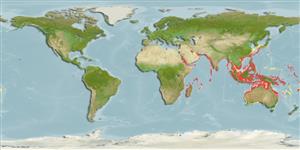
Indian Ocean: India, Sri Lanka (Arabian Sea, Laccadive Sea and Bay of Bengal) and nw Indonesia (off Singapore); questionable in Myanmar and Taiwan.
Chiều dài lúc trưởng thành đầu tiên / Bộ gần gũi / Khối lượng (Trọng lượng) / Tuổi
Chín muồi sinh dục: Lm 19.0 range ? - ? cm
Max length : 25.5 cm WD con đực/không giới tính; (Ref. 121648); 31.0 cm WD (female); Khối lượng cực đại được công bố: 590.00 g (Ref. 121648); Khối lượng cực đại được công bố: 590.00 g
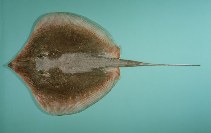
Disc width equal to disc length; tail shorter than body; ventral surface of disc entirely white (Ref. 12693).
Body shape (shape guide): other.
Found in inshore coastal waters (Ref. 30573). Typically found in estuarine habitats, but also reported from the Great Lake. The single record from the Great Lake may in fact refer to Dasyatis laosensis. Young and adults feed on benthic invertebrates (Ref. 12693). Ovoviviparous (Ref. 124). Feeds on bottom-living invertebrates (Ref. 68964). May grow to a maximum of 140 cm disc length in the sea (Ref. 43081). Juveniles may be present in mangroves (Ref. 43081). Examined adult males 17.1 cm DW (32.0 cm TL) - 20.5 cm DW (39.8 cm TL); females 13.8 cm DW (25.6 cm TL) - 20.4 cm DW (39.6 cm TL); early juveniles (USNM 222564, immature male 12.0 cm DW and female 8.8 cm DW) have lost umbilical scars. Reported maximum disc width 30.0 cm (Ref. 11312) was found excessive (Ref. 130662).
Exhibit ovoviparity (aplacental viviparity), with embryos feeding initially on yolk, then receiving additional nourishment from the mother by indirect absorption of uterine fluid enriched with mucus, fat or protein through specialised structures (Ref. 50449). Distinct pairing with embrace (Ref. 205).
Last, P.R., S. Weigmann and G.J.P. Naylor, 2023. The Indo-Pacific stingray genus Brevitrygon (Myliobatiformes: Dasyatidae): clarification of historical names and description of a new species, B. manjajiae sp. nov., from the western Indian Ocean. Diversity 15: 1-75. (Ref. 130662)
Tình trạng Sách đỏ IUCN (Ref. 130435: Version 2025-2 (Global))
Mối đe dọa đối với con người
Sử dụng của con người
Các nghề cá: buôn bán nhỏ
Các công cụ
Báo cáo đặc biệt
Tải xuống XML
Các nguồn internet
Ước tính dựa trên mô hình
Nhiệt độ ưa thích (Tài liệu tham khảo
123201): 26.4 - 29.2, mean 28.4 °C (based on 1288 cells).
Chỉ số đa dạng phát sinh loài (Tài liệu tham khảo
82804): PD
50 = 0.5312 [Uniqueness, from 0.5 = low to 2.0 = high].
Bayesian length-weight: a=0.01698 (0.01048 - 0.02752), b=3.12 (2.97 - 3.27), in cm total length, based on LWR estimates for this species & (Sub)family-body (Ref.
93245).
Mức dinh dưỡng (Tài liệu tham khảo
69278): 3.5 ±0.37 se; based on food items.
Generation time: 1.9 ( na - na) years. Estimated as median ln(3)/K based on 2
growth studies.
Thích nghi nhanh (Tài liệu tham khảo
120179): Rất thấp, thời gian nhân đôi của chủng quần tối thiểu là hơn 14 năm (K=0.59; Fec=1).
Sự dễ bị tổn thương của nghề đánh cá (Ref.
59153): Moderate vulnerability (42 of 100).
🛈