Elasmobranchii (haaien en roggen) (sharks and rays) >
Myliobatiformes (Stingrays) >
Dasyatidae (Stingrays) > Urogymninae
Etymology: Brevitrygon: Name from Latin 'brevis' meaning short and 'trygṓn' meaning stingray, referring to the short, semi-rigid tails of these stingrays; imbricata: Name fro Latin 'imbricata' meaning overlapping each other, referring to the secondary denticle band, which is very narrow over the branchial region and abdomen in this species.
More on authors: Bloch & Schneider.
Milieu: milieu / Klimaatzone / Diepte / verspreidingsgebied
Ecologie
marien; zoet water; brak water demersaal; amfidroom (Ref. 51243); diepte 1 - 45 m (Ref. 130662). Tropical
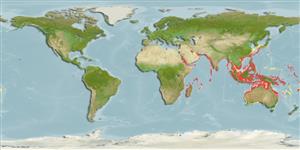
Indian Ocean: India, Sri Lanka (Arabian Sea, Laccadive Sea and Bay of Bengal) and nw Indonesia (off Singapore); questionable in Myanmar and Taiwan.
Lengte bij maturiteit / Grootte / Gewicht / Leeftijd
Maturiteit: Lm 19.0 range ? - ? cm
Max length : 25.5 cm WD mannelijk / geslacht onbekend; (Ref. 121648); 31.0 cm WD (female); max. gepubliceerd gewicht: 590.00 g (Ref. 121648); max. gepubliceerd gewicht: 590.00 g
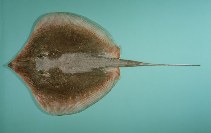
Disc width equal to disc length; tail shorter than body; ventral surface of disc entirely white (Ref. 12693).
Body shape (shape guide): other.
Found in inshore coastal waters (Ref. 30573). Typically found in estuarine habitats, but also reported from the Great Lake. The single record from the Great Lake may in fact refer to Dasyatis laosensis. Young and adults feed on benthic invertebrates (Ref. 12693). Ovoviviparous (Ref. 124). Feeds on bottom-living invertebrates (Ref. 68964). May grow to a maximum of 140 cm disc length in the sea (Ref. 43081). Juveniles may be present in mangroves (Ref. 43081). Examined adult males 17.1 cm DW (32.0 cm TL) - 20.5 cm DW (39.8 cm TL); females 13.8 cm DW (25.6 cm TL) - 20.4 cm DW (39.6 cm TL); early juveniles (USNM 222564, immature male 12.0 cm DW and female 8.8 cm DW) have lost umbilical scars. Reported maximum disc width 30.0 cm (Ref. 11312) was found excessive (Ref. 130662).
Exhibit ovoviparity (aplacental viviparity), with embryos feeding initially on yolk, then receiving additional nourishment from the mother by indirect absorption of uterine fluid enriched with mucus, fat or protein through specialised structures (Ref. 50449). Distinct pairing with embrace (Ref. 205).
Last, P.R., S. Weigmann and G.J.P. Naylor, 2023. The Indo-Pacific stingray genus Brevitrygon (Myliobatiformes: Dasyatidae): clarification of historical names and description of a new species, B. manjajiae sp. nov., from the western Indian Ocean. Diversity 15: 1-75. (Ref. 130662)
Status op de Rode Lijst van het IUCN (Ref. 130435: Version 2025-2 (Global))
Gebruik door de mens
Visserij: van minder commercieel belang
Tools
Speciale rapporten
Download XML
Internetbronnen
Schattingen op basis van modellen
Gewenste temperatuur (Ref.
123201): 26.4 - 29.2, mean 28.4 °C (based on 1288 cells).
Fylogenetische diversiteitsindex (Ref.
82804): PD
50 = 0.5312 [Uniqueness, from 0.5 = low to 2.0 = high].
Bayesian length-weight: a=0.01698 (0.01048 - 0.02752), b=3.12 (2.97 - 3.27), in cm total length, based on LWR estimates for this species & (Sub)family-body (Ref.
93245).
Trofisch niveau (Ref.
69278): 3.5 ±0.37 se; based on food items.
Generation time: 1.9 ( na - na) years. Estimated as median ln(3)/K based on 2
growth studies.
Weerstandsvermogen (Ref.
120179): Zeer laag, minimale populatieverdubbelingstijd meer dan 14 jaar (K=0.59; Fec=1).
Kwetsbaarheid van de visserij (Ref.
59153): Moderate vulnerability (42 of 100).
🛈