Ikan bertulang rawan (sharks and rays) >
Myliobatiformes (Stingrays) >
Dasyatidae (Stingrays) > Urogymninae
Etymology: Brevitrygon: Name from Latin 'brevis' meaning short and 'trygṓn' meaning stingray, referring to the short, semi-rigid tails of these stingrays; imbricata: Name fro Latin 'imbricata' meaning overlapping each other, referring to the secondary denticle band, which is very narrow over the branchial region and abdomen in this species.
More on authors: Bloch & Schneider.
Lingkungan: lingkungan / zona iklim / kisaran kedalaman / jangkauan distribusi
Ekologi
laut; air tawar; payau dasar (demersal); amphidromus (Ref. 51243); kisaran kedalaman 1 - 45 m (Ref. 130662). Tropical
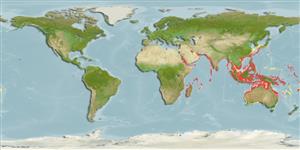
Indian Ocean: India, Sri Lanka (Arabian Sea, Laccadive Sea and Bay of Bengal) and nw Indonesia (off Singapore); questionable in Myanmar and Taiwan.
Panjang pada saat jatuh tempo pertama / Ukuran / Berat / umur
Kematangan: Lm 19.0 range ? - ? cm
Max length : 25.5 cm WD jantan/; (Ref. 121648); 31.0 cm WD (female); Berat maksimum terpublikasi: 590.00 g (Ref. 121648); Berat maksimum terpublikasi: 590.00 g
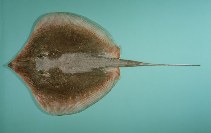
Disc width equal to disc length; tail shorter than body; ventral surface of disc entirely white (Ref. 12693).
Body shape (shape guide): other.
Found in inshore coastal waters (Ref. 30573). Typically found in estuarine habitats, but also reported from the Great Lake. The single record from the Great Lake may in fact refer to Dasyatis laosensis. Young and adults feed on benthic invertebrates (Ref. 12693). Ovoviviparous (Ref. 124). Feeds on bottom-living invertebrates (Ref. 68964). May grow to a maximum of 140 cm disc length in the sea (Ref. 43081). Juveniles may be present in mangroves (Ref. 43081). Examined adult males 17.1 cm DW (32.0 cm TL) - 20.5 cm DW (39.8 cm TL); females 13.8 cm DW (25.6 cm TL) - 20.4 cm DW (39.6 cm TL); early juveniles (USNM 222564, immature male 12.0 cm DW and female 8.8 cm DW) have lost umbilical scars. Reported maximum disc width 30.0 cm (Ref. 11312) was found excessive (Ref. 130662).
Exhibit ovoviparity (aplacental viviparity), with embryos feeding initially on yolk, then receiving additional nourishment from the mother by indirect absorption of uterine fluid enriched with mucus, fat or protein through specialised structures (Ref. 50449). Distinct pairing with embrace (Ref. 205).
Last, P.R., S. Weigmann and G.J.P. Naylor, 2023. The Indo-Pacific stingray genus Brevitrygon (Myliobatiformes: Dasyatidae): clarification of historical names and description of a new species, B. manjajiae sp. nov., from the western Indian Ocean. Diversity 15: 1-75. (Ref. 130662)
Status IUCN Red List (Ref. 130435: Version 2025-2 (Global))
penggunaan manusia
Perikanan: nilai komersial kecil
Alat, peralatan
laporan khas
muat turun XML
Sumber internet
Estimasi berdasarkan model
Suhu yang disukai (Acuan
123201): 26.4 - 29.2, mean 28.4 °C (based on 1288 cells).
Indeks keanekaragaman filogenetik (Acuan
82804): PD
50 = 0.5312 [Uniqueness, from 0.5 = low to 2.0 = high].
Bayesian length-weight: a=0.01698 (0.01048 - 0.02752), b=3.12 (2.97 - 3.27), in cm total length, based on LWR estimates for this species & (Sub)family-body (Ref.
93245).
Tingkat Trofik (Acuan
69278): 3.5 ±0.37 se; based on food items.
Generation time: 1.9 ( na - na) years. Estimated as median ln(3)/K based on 2
growth studies.
Daya lenting (Acuan
120179): sangat rendah, Waktu penggandaan populasi minimum lebih dari 14 tahun (K=0.59; Fec=1).
Kerentanan Penangkapan Ikan (Ref.
59153): Moderate vulnerability (42 of 100).
🛈