>
Scombriformes (Mackerels) >
Scombridae (Mackerels, tunas, bonitos) > Scombrinae
Etymology: Scomber: Greek, skombros = tunny or mackerel, 1623 (Ref. 45335).
More on author: Cuvier.
पर्यावरण: पर्यावरण / जलवायु क्षेत्र / गहराई सीमा / वितरण सीमा
पारिस्थितिकी
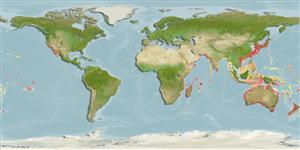
समुद्री pelagic-neritic; औशिनोड़िरोमस (Ref. 51243); गहराई सीमा 87 - 200 m (Ref. 9563). Subtropical; 43°N - 50°S, 32°E - 110°W (Ref. 168)
Indo-West Pacific: Red Sea, Persian Gulf; from Japan, south to Australia and New Zealand. Eastern Pacific: Hawaii and off Mexico (Socorro Island).
आकार / वज़न / आयु
परिपक्व अवधि: Lm ? range ? - ? cm
Max length : 50.2 cm SL पुल्लिंग / अलिंग; (Ref. 137577); common length : 30.0 cm FL पुल्लिंग / अलिंग; (Ref. 168); अधिकतम प्रकाशित वज़न: 1.4 kg (Ref. 40637)
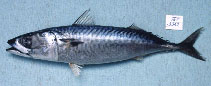
पृष्ठीय रीढ़ (सम्पूर्ण) : 10 - 13; पृष्ठीय सौफट रेज़ (सम्पूर्ण) : 12; गुदा कांटा: 0; ऐनल सौफट रेज़: 12; जानवरों की रीड़ का जोड़: 31. No well developed corselet but body covered with rather small scales. Palatine narrow. Anal fin origin clearly more posterior than that of second dorsal fin. Anal fin spine independent from anal fin. Swim bladder present. Snout pointed. Interpelvic process small and single. Back with narrow oblique lines which zigzag and undulate; the belly is pearly white and marked with thin, wavy broken lines.
Body shape (shape guide): fusiform / normal; Cross section: oval.
Occurs in coastal waters (Ref. 9340) and also in oceanic waters (Ref. 9563). Minimum depth reported at 87 m (Ref. 58489); fishing depths to 265 m (cited in Ref. 58302). Schooling by size which may include jack mackerels and Pacific sardines. They are plankton feeders filtering copepods and other crustaceans, but adults also feed on small fish and squids. Also caught with encircling nets (Ref. 9340). Marketed fresh, dried-salted, smoked, canned and frozen (Ref. 9987).
जीवन चक्र और संभोग व्यवहार
परिपक्व अवधि | पुनरुत्पत्ति | मछलीऔ का अंडे देना | अंडे | उपजाऊपन | लार्वा
Collette, B.B. and C.E. Nauen, 1983. FAO Species Catalogue. Vol. 2. Scombrids of the world. An annotated and illustrated catalogue of tunas, mackerels, bonitos and related species known to date. Rome: FAO. FAO Fish. Synop. 125(2):137 p. (Ref. 168)
आईयूसीएन रेड लिस्ट स्थिति (Ref. 130435: Version 2025-2 (Global))
मनुष्यों के लिए ख़तरा
Harmless
मानव उपयोग
मात्स्यिकी: व्यापारिक; आखेट मत्स्य: हां; ठहराव / प्रलोभन: usually
साधन
विशेष रिपोर्ट
XML डाउनलोड करें
इंटरनेट स्रोत
मॉडल पर आधारित अनुमान
पसंदीदा तापमान (संदर्भ
123201): 10.8 - 24.3, mean 18.7 °C (based on 185 cells).
जातिवृति विविधता सूचकांक (संदर्भ
82804): PD
50 = 0.5625 [Uniqueness, from 0.5 = low to 2.0 = high].
Bayesian length-weight: a=0.00912 (0.00799 - 0.01040), b=3.05 (3.01 - 3.09), in cm total length, based on LWR estimates for this species (Ref.
93245).
ट्रॉफिक स्तर (संदर्भ
69278): 4.2 ±0.5 se; based on diet studies.
लौटाव (संदर्भ
120179): माध्यम, न्यूनतम जनसंख्या दुगनी होने का समय 1.4 - 4.4 वर्ष। (K=0.28).
Prior r = 0.60, 95% CL = 0.39 - 0.90, Based on 1 full stock assessment.
मछली पकड़ने की भेद्यता (Ref.
59153): Moderate vulnerability (44 of 100).
🛈
जलवायु भेद्यता (Ref.
125649): Low to moderate vulnerability (30 of 100).
🛈
पोषक तत्व (Ref.
124155): Calcium = 52.1 [17.4, 129.4] mg/100g; Iron = 2 [1, 5] mg/100g; Protein = 21 [20, 22] %; Omega3 = 0.392 [0.257, 0.600] g/100g; Selenium = 74.3 [27.5, 192.3] μg/100g; VitaminA = 24.7 [5.9, 109.4] μg/100g; Zinc = 0.822 [0.487, 1.377] mg/100g (wet weight);