>
Characiformes (Characins) >
Lebiasinidae (Pencilfishes) > Pyrrhulininae
Eponymy: Edward Drinker Cope (1840–1897) was an American palaeontologist, anatomist, herpetologist and ichthyologist. [...] Johann Paul Arnold (1869–1952) was a German aquarist in Hamburg. He sent specimens to Boulenger for study and identification. He co-wrote: The alien freshwater fish (1936). (Ref. 128868), visit book page.
More on author: Regan.
Taxonomic Remarks
Regan (1912) described three Copella species from the Atlantic coastal region between the mouth of the Orinoco in Venezuela and the mouth of the Amazon in Pará Brazil, C. arnoldi, C. carsevennensis, and C. eigenmanni. No recent review has been produced to clarify their identities or relationships. The ‘splash tetra’ has been in the aquarium trade for a long time. This species lays its eggs on the underside of leaves just above the water line and the adults, mainly the male, splash water on the eggs until they hatch. The breeding behavior of the other two species has not been recorded. Other species of the genus lay their eggs on leaves near the surface but under water. See Planquette, Keith and Le Bail, 1996:178, for notes on the fish in French Guyana.
Môi trường: môi trường / vùng khí hậu / Mức độ sâu / phạm vi phân phối
Sinh thái học
; nước ngọt sống nổi và đáy; pH range: 6.0 - 8.0; dH range: 5 - 12. Tropical; 25°C - 29°C (Ref. 1672)
South America: lower rio Amazonas basin, coastal drainages of Pará and Amapá, Brazil,
Guyana, French Guiana, Surinam, mouth of rio Orinoco, and coastal drainages of Sucre and Monagas, Venezuela.
Bộ gần gũi / Khối lượng (Trọng lượng) / Tuổi
Chín muồi sinh dục: Lm ? range ? - ? cm
Max length : 4.2 cm SL con đực/không giới tính; (Ref. 137764); 3.3 cm SL (female); Khối lượng cực đại được công bố: 0.33 g (Ref. 125972)
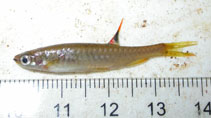
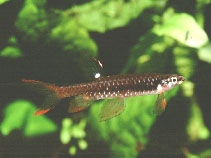
Các vây lưng mềm (tổng cộng) : 8; Tia mềm vây hậu môn: 9; Động vật có xương sống: 37. This species is distinguished from all its congeners, except some specimens of C. nattereri by the procurrent caudal-fin rays that are hyaline (vs. black); further differs from C. nattereri by the absence of a black mark on each body scale (vs. presence); further differs from all its congeners by having a pigmented area extending anterodorsally from ventral tip of the dentary to ventral portion of the eye (vs. absent). Colouration: some males are unique in having brilliant white spots on scales of the third, fourth, fifth, and sixth longitudinal scale rows (Ref. 137764).
Body shape (shape guide): elongated; Cross section: circular.
Occurs in groups at the surface of small creeks with clear waters. Also found in ponds where it is found together with Rivulus (Ref. 27188). Feeds on Ephemeroptera larvae and ants (Ref. 12225); also on worms, insects and crustaceans (Ref. 7020). Known among aquarists by its unique breeding behavior and parental care: male and the female line up side by side at the surface of the water and jump together out of the water, to spawn. The fertilized eggs are then laid on the underside of an emergent leaf and the male then splashes them with its tail for about three days until they hatch, hence the popular name 'Splash tetra'. It was also observed that just before lining up to jump out of the water toward the upper glass of the aquarium, the female follows the male, touching her abdomen at the anterodorsal portion of the male several
times, swimming agitatedly (Ref. 137764). The spawned eggs are deposited on submerged leaves and are guarded by the males (Ref. 12225). During incubation, the male oxygenates the eggs (Ref. 27188).
Vòng đời và hành vi giao phối
Chín muồi sinh dục | Sự tái sinh sản | Đẻ trứng | Các trứng | Sự sinh sản | Ấu trùng
Deposits eggs on underside of objects above the water surface. Male in water splashes the clutch periodically (Ref. 7471). In the aquarium, male and female swim vertically to the surface, flick their tails and leap up to a leaf. Female lays from 5 to 8 eggs on the leaf and male fertilizes them immediately. This procedure is repeated several times until some hundreds of eggs have been laid. Male then keeps the eggs damp by flicking his tail to spray them with water. As eggs hatch, fry fall into the water (Ref. 7020).
Marinho, M.M.F. and N.A. Menezes, 2017. Taxonomic review of Copella (Characiformes: Lebiasinidae) with an identification key for the species. PLoS ONE 12(8):e0183069:1-53. (Ref. 137764)
Tình trạng Sách đỏ IUCN (Ref. 130435: Version 2025-2 (Global))
Mối đe dọa đối với con người
Harmless
Sử dụng của con người
Các nghề cá: tính thương mại; Bể nuôi cá: Tính thương mại
Các công cụ
Báo cáo đặc biệt
Tải xuống XML
Các nguồn internet
Ước tính dựa trên mô hình
Chỉ số đa dạng phát sinh loài (Tài liệu tham khảo
82804): PD
50 = 0.5156 [Uniqueness, from 0.5 = low to 2.0 = high].
Bayesian length-weight: a=0.00661 (0.00388 - 0.01125), b=3.11 (2.96 - 3.26), in cm total length, based on LWR estimates for this species & (Sub)family-body (Ref.
93245).
Mức dinh dưỡng (Tài liệu tham khảo
69278): 3.3 ±0.40 se; based on food items.
Thích nghi nhanh (Tài liệu tham khảo
120179): Trung bình, thời gian nhân đôi của chủng quần tối thiểu là 1.4 - 4.4 năm (Females can lay hundreds of eggs (Ref.
7020)).
Sự dễ bị tổn thương của nghề đánh cá (Ref.
59153): Low vulnerability (10 of 100).
🛈