>
Characiformes (Characins) >
Lebiasinidae (Pencilfishes) > Pyrrhulininae
Eponymy: Edward Drinker Cope (1840–1897) was an American palaeontologist, anatomist, herpetologist and ichthyologist. [...] Johann Paul Arnold (1869–1952) was a German aquarist in Hamburg. He sent specimens to Boulenger for study and identification. He co-wrote: The alien freshwater fish (1936). (Ref. 128868), visit book page.
More on author: Regan.
Taxonomic Remarks
Regan (1912) described three Copella species from the Atlantic coastal region between the mouth of the Orinoco in Venezuela and the mouth of the Amazon in Pará Brazil, C. arnoldi, C. carsevennensis, and C. eigenmanni. No recent review has been produced to clarify their identities or relationships. The ‘splash tetra’ has been in the aquarium trade for a long time. This species lays its eggs on the underside of leaves just above the water line and the adults, mainly the male, splash water on the eggs until they hatch. The breeding behavior of the other two species has not been recorded. Other species of the genus lay their eggs on leaves near the surface but under water. See Planquette, Keith and Le Bail, 1996:178, for notes on the fish in French Guyana.
Окружающая среда: среда / климатическая зона / пределы глубины / диапазон распространения
экология
; пресноводный донно-пелагический; pH range: 6.0 - 8.0; dH range: 5 - 12. Tropical; 25°C - 29°C (Ref. 1672)
South America: lower rio Amazonas basin, coastal drainages of Pará and Amapá, Brazil,
Guyana, French Guiana, Surinam, mouth of rio Orinoco, and coastal drainages of Sucre and Monagas, Venezuela.
Размер / Вес / Возраст
половая зрелость: Lm ? range ? - ? cm
Max length : 4.2 cm SL самец/пол неопределен; (Ref. 137764); 3.3 cm SL (female); наибольший вес (опубликованные данные): 0.33 g (Ref. 125972)
Краткое описание
определительные ключи | морфология | морфометрия
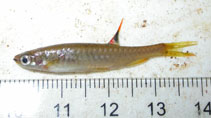
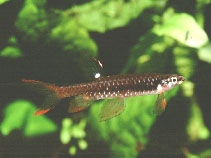
членистые (мягкие) лучи спинного плавника (общее число) : 8; членистые (мягкие) лучи анального плавника: 9; позвонки: 37. This species is distinguished from all its congeners, except some specimens of C. nattereri by the procurrent caudal-fin rays that are hyaline (vs. black); further differs from C. nattereri by the absence of a black mark on each body scale (vs. presence); further differs from all its congeners by having a pigmented area extending anterodorsally from ventral tip of the dentary to ventral portion of the eye (vs. absent). Colouration: some males are unique in having brilliant white spots on scales of the third, fourth, fifth, and sixth longitudinal scale rows (Ref. 137764).
Body shape (shape guide): elongated; Cross section: circular.
Occurs in groups at the surface of small creeks with clear waters. Also found in ponds where it is found together with Rivulus (Ref. 27188). Feeds on Ephemeroptera larvae and ants (Ref. 12225); also on worms, insects and crustaceans (Ref. 7020). Known among aquarists by its unique breeding behavior and parental care: male and the female line up side by side at the surface of the water and jump together out of the water, to spawn. The fertilized eggs are then laid on the underside of an emergent leaf and the male then splashes them with its tail for about three days until they hatch, hence the popular name 'Splash tetra'. It was also observed that just before lining up to jump out of the water toward the upper glass of the aquarium, the female follows the male, touching her abdomen at the anterodorsal portion of the male several
times, swimming agitatedly (Ref. 137764). The spawned eggs are deposited on submerged leaves and are guarded by the males (Ref. 12225). During incubation, the male oxygenates the eggs (Ref. 27188).
Жизненный цикл и брачное поведение
половая зрелость | размножение | нерест | икра | Плодовитость | личинки
Deposits eggs on underside of objects above the water surface. Male in water splashes the clutch periodically (Ref. 7471). In the aquarium, male and female swim vertically to the surface, flick their tails and leap up to a leaf. Female lays from 5 to 8 eggs on the leaf and male fertilizes them immediately. This procedure is repeated several times until some hundreds of eggs have been laid. Male then keeps the eggs damp by flicking his tail to spray them with water. As eggs hatch, fry fall into the water (Ref. 7020).
Marinho, M.M.F. and N.A. Menezes, 2017. Taxonomic review of Copella (Characiformes: Lebiasinidae) with an identification key for the species. PLoS ONE 12(8):e0183069:1-53. (Ref. 137764)
Статус Красного Списка МСОП (Ref. 130435: Version 2025-2 (Global))
Угроза для людей
Harmless
Использование человеком
рыболовство: коммерческий; аквариум: коммерческий
дополнительная информация
инструменты
Специальные отчеты
Скачать в формате XML
ресурсы в Интернет
Оценки, основанные на моделях
Индекс филогенетического разнообразия (ссылка
82804): PD
50 = 0.5156 [Uniqueness, from 0.5 = low to 2.0 = high].
Bayesian length-weight: a=0.00661 (0.00388 - 0.01125), b=3.11 (2.96 - 3.26), in cm total length, based on LWR estimates for this species & (Sub)family-body (Ref.
93245).
Трофический уровень (ссылка
69278): 3.3 ±0.40 se; based on food items.
устойчивость к внешним воздействиям (ссылка
120179): средний (среднего размера), минимальное время удвоения популяции 1.4-4.4 года (Females can lay hundreds of eggs (Ref.
7020)).
Уязвимость рыбной ловли (Ref.
59153): Low vulnerability (10 of 100).
🛈