分類 / 名前
共通名の | 類義語 | Catalog of Fishes(部類, 種) | ITIS | CoL | WoRMS | Cloffa
>
Characiformes (Characins) >
Lebiasinidae (Pencilfishes) > Pyrrhulininae
Eponymy: Edward Drinker Cope (1840–1897) was an American palaeontologist, anatomist, herpetologist and ichthyologist. [...] Johann Paul Arnold (1869–1952) was a German aquarist in Hamburg. He sent specimens to Boulenger for study and identification. He co-wrote: The alien freshwater fish (1936). (Ref. 128868), visit book page.
More on author: Regan.
Taxonomic Remarks
Regan (1912) described three Copella species from the Atlantic coastal region between the mouth of the Orinoco in Venezuela and the mouth of the Amazon in Pará Brazil, C. arnoldi, C. carsevennensis, and C. eigenmanni. No recent review has been produced to clarify their identities or relationships. The ‘splash tetra’ has been in the aquarium trade for a long time. This species lays its eggs on the underside of leaves just above the water line and the adults, mainly the male, splash water on the eggs until they hatch. The breeding behavior of the other two species has not been recorded. Other species of the genus lay their eggs on leaves near the surface but under water. See Planquette, Keith and Le Bail, 1996:178, for notes on the fish in French Guyana.
環境:環境 / 気候帯 / 深さの範囲 / 分布範囲
生態学
; 新鮮な水 底生の漂泳性; pH range: 6.0 - 8.0; dH range: 5 - 12. Tropical; 25°C - 29°C (Ref. 1672)
South America: lower rio Amazonas basin, coastal drainages of Pará and Amapá, Brazil,
Guyana, French Guiana, Surinam, mouth of rio Orinoco, and coastal drainages of Sucre and Monagas, Venezuela.
サイズ / 重さ / 年齢
成熟: Lm ? range ? - ? cm
Max length : 4.2 cm SL オス/雌雄の選別がない; (Ref. 137764); 3.3 cm SL (female); 最大公表体重: 0.33 g (Ref. 125972)
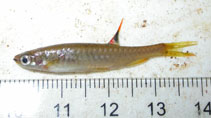
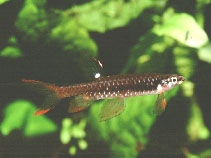
背鰭 (合計) : 8; 臀鰭: 9; 脊つい: 37. This species is distinguished from all its congeners, except some specimens of C. nattereri by the procurrent caudal-fin rays that are hyaline (vs. black); further differs from C. nattereri by the absence of a black mark on each body scale (vs. presence); further differs from all its congeners by having a pigmented area extending anterodorsally from ventral tip of the dentary to ventral portion of the eye (vs. absent). Colouration: some males are unique in having brilliant white spots on scales of the third, fourth, fifth, and sixth longitudinal scale rows (Ref. 137764).
Body shape (shape guide): elongated; Cross section: circular.
Occurs in groups at the surface of small creeks with clear waters. Also found in ponds where it is found together with Rivulus (Ref. 27188). Feeds on Ephemeroptera larvae and ants (Ref. 12225); also on worms, insects and crustaceans (Ref. 7020). Known among aquarists by its unique breeding behavior and parental care: male and the female line up side by side at the surface of the water and jump together out of the water, to spawn. The fertilized eggs are then laid on the underside of an emergent leaf and the male then splashes them with its tail for about three days until they hatch, hence the popular name 'Splash tetra'. It was also observed that just before lining up to jump out of the water toward the upper glass of the aquarium, the female follows the male, touching her abdomen at the anterodorsal portion of the male several
times, swimming agitatedly (Ref. 137764). The spawned eggs are deposited on submerged leaves and are guarded by the males (Ref. 12225). During incubation, the male oxygenates the eggs (Ref. 27188).
ライフサイクルと交尾行動
成熟 | 繁殖 | 放精 | 卵 | 生産力 | 幼生
Deposits eggs on underside of objects above the water surface. Male in water splashes the clutch periodically (Ref. 7471). In the aquarium, male and female swim vertically to the surface, flick their tails and leap up to a leaf. Female lays from 5 to 8 eggs on the leaf and male fertilizes them immediately. This procedure is repeated several times until some hundreds of eggs have been laid. Male then keeps the eggs damp by flicking his tail to spray them with water. As eggs hatch, fry fall into the water (Ref. 7020).
Marinho, M.M.F. and N.A. Menezes, 2017. Taxonomic review of Copella (Characiformes: Lebiasinidae) with an identification key for the species. PLoS ONE 12(8):e0183069:1-53. (Ref. 137764)
IUCNのレッドリストの状況は (Ref. 130435: Version 2025-2 (Global))
人間の用途
水産業: 商業; 水族館・水槽: 商業
用具
特記事項
XMLをダウンロードして下さい
インターネットの情報源
モデルに基づく推定値
系統多様性指数 (参照
82804): PD
50 = 0.5156 [Uniqueness, from 0.5 = low to 2.0 = high].
Bayesian length-weight: a=0.00661 (0.00388 - 0.01125), b=3.11 (2.96 - 3.26), in cm total length, based on LWR estimates for this species & (Sub)family-body (Ref.
93245).
栄養段階 (参照
69278): 3.3 ±0.40 se; based on food items.
回復力 (参照
120179): 手段, 1.4年~4.4年の倍増期間の最小個体群 (Females can lay hundreds of eggs (Ref.
7020)).
漁業の脆弱性 (Ref.
59153): Low vulnerability (10 of 100).
🛈