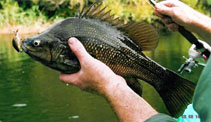
Môi trường: môi trường / vùng khí hậu / Mức độ sâu / phạm vi phân phối
Sinh thái học
; nước ngọt sống nổi và đáy; di cư trong nước ngọt (Ref. 51243); mức độ sâu 0 - 4 m. Temperate; 4°C - 25°C (Ref. 2060); 34°S - 37°S
Oceania: Once widely distributed in the Murray-Darling basin and southeastern coastal drainages. Now reduced to cooler upper reaches of Murray-Darling basin, New South Wales, Australia. Introduced in the Wannon, Barwon, Yarra Rivers (Victoria) and the Nepean and Shoalhaven Rivers (New South Wales), Australia.
Chiều dài lúc trưởng thành đầu tiên / Bộ gần gũi / Khối lượng (Trọng lượng) / Tuổi
Chín muồi sinh dục: Lm ? range ? - 30 cm
Max length : 46.0 cm SL con đực/không giới tính; (Ref. 44894); common length : 23.0 cm SL con đực/không giới tính; (Ref. 5259); Khối lượng cực đại được công bố: 3.5 kg (Ref. 2906)
Các tia vây lưng cứng (tổng cộng) : 8 - 12; Các vây lưng mềm (tổng cộng) : 12 - 15; Tia cứng vây hậu môn: 3; Tia mềm vây hậu môn: 8 - 11; Động vật có xương sống: 28 - 31.
Body shape (shape guide): short and / or deep.
Occurs in lakes and flowing streams usually in deep holes with rock or gravel substrates (Ref. 5259). Inhabits cool, clear water of rivers, lakes and reservoirs. Prefers slow-flowing, deep rocky pools. Solitary, swimming near the bottom or in mid-water, but form small shoals during the spawning season (October to December) (Ref. 44894). Forms large shoals near shore. Fry feeds on zooplankton; adult on aquatic insects, crustaceans and mollusks. Male matures at 20 cm (2 y), female at 30 cm (3 y). Spawns upstream in spring or early summer; eggs hatch in 13-18 days; larvae of 7 cm TL (Ref. 5259). Moves into areas just upstream of shallow riffles over gravel or rocky bottoms to spawn. The female releases demersal eggs which sink into cracks in the substrate. Fish in reservoirs move into flowing feeder streams to spawn. Sexual maturity is reached after 2 years (20 centimeters) for males, 3 years (30 centimeters) for females (Ref. 44894). Tolerates temp. down to 9°C (Ref. 7276). Infected by nematodes and copepod Lernaea cyprinacea (Ref. 7315).
Return to same river or lake site to spawn each year. Sexually segregated schools (uniform size & age-bet. 4-10 y) migrate upstream: female groups some days or weeks in advance. Most abundant in lakes fed by suitable shallow streams with rock or gravel substrates. Male nudges female vent region; eggs released, fertilized. Eggs turn transparent, increase to 4.0 mm diameter, are spherical, adhesive and demersal and are swept downstream lodging in boulders and pebbles. Hatching in 10-18 days (11-18°C). Larvae shelter in boulders.
Paxton, J.R., D.F. Hoese, G.R. Allen and J.E. Hanley, 1989. Pisces. Petromyzontidae to Carangidae. Zoological Catalogue of Australia, Vol. 7. Australian Government Publishing Service, Canberra, 665 p. (Ref. 7300)
Tình trạng Sách đỏ IUCN (Ref. 130435: Version 2025-2 (Global))
Mối đe dọa đối với con người
Sử dụng của con người
Các nghề cá: tính thương mại; Nuôi trồng thủy sản: tính thương mại; cá để chơi: đúng; Bể nuôi cá: Tính thương mại
Các công cụ
Báo cáo đặc biệt
Tải xuống XML
Các nguồn internet
Ước tính dựa trên mô hình
Chỉ số đa dạng phát sinh loài (Tài liệu tham khảo
82804): PD
50 = 0.7500 [Uniqueness, from 0.5 = low to 2.0 = high].
Bayesian length-weight: a=0.01738 (0.00677 - 0.04463), b=3.06 (2.83 - 3.29), in cm total length, based on LWR estimates for this (Sub)family-body shape (Ref.
93245).
Mức dinh dưỡng (Tài liệu tham khảo
69278): 3.3 ±0.01 se; based on food items.
Thích nghi nhanh (Tài liệu tham khảo
120179): Trung bình, thời gian nhân đôi của chủng quần tối thiểu là 1.4 - 4.4 năm (tm=2-3).
Sự dễ bị tổn thương của nghề đánh cá (Ref.
59153): Moderate vulnerability (42 of 100).
🛈