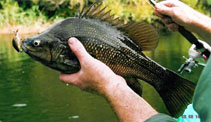
Ambiente: milieu / zona climatica / distribuzione batimetrica / gamma di distribuzione
Ecologia
; acqua dolce benthopelagico; potamodromo (Ref. 51243); distribuzione batimetrica 0 - 4 m. Temperate; 4°C - 25°C (Ref. 2060); 34°S - 37°S
Oceania: Once widely distributed in the Murray-Darling basin and southeastern coastal drainages. Now reduced to cooler upper reaches of Murray-Darling basin, New South Wales, Australia. Introduced in the Wannon, Barwon, Yarra Rivers (Victoria) and the Nepean and Shoalhaven Rivers (New South Wales), Australia.
Lunghezza alla prima maturità / Dimensione / Peso / Età
Maturità: Lm ? range ? - 30 cm
Max length : 46.0 cm SL maschio/sesso non determinato; (Ref. 44894); common length : 23.0 cm SL maschio/sesso non determinato; (Ref. 5259); peso massimo pubblicato: 3.5 kg (Ref. 2906)
Breve descrizione
Chiavi di identificazione | Morfologia | Morfometria
Spine dorsali (totale) : 8 - 12; Raggi dorsali molli (totale) : 12 - 15; Spine anali: 3; Raggi anali molli: 8 - 11; Vertebre: 28 - 31.
Body shape (shape guide): short and / or deep.
Occurs in lakes and flowing streams usually in deep holes with rock or gravel substrates (Ref. 5259). Inhabits cool, clear water of rivers, lakes and reservoirs. Prefers slow-flowing, deep rocky pools. Solitary, swimming near the bottom or in mid-water, but form small shoals during the spawning season (October to December) (Ref. 44894). Forms large shoals near shore. Fry feeds on zooplankton; adult on aquatic insects, crustaceans and mollusks. Male matures at 20 cm (2 y), female at 30 cm (3 y). Spawns upstream in spring or early summer; eggs hatch in 13-18 days; larvae of 7 cm TL (Ref. 5259). Moves into areas just upstream of shallow riffles over gravel or rocky bottoms to spawn. The female releases demersal eggs which sink into cracks in the substrate. Fish in reservoirs move into flowing feeder streams to spawn. Sexual maturity is reached after 2 years (20 centimeters) for males, 3 years (30 centimeters) for females (Ref. 44894). Tolerates temp. down to 9°C (Ref. 7276). Infected by nematodes and copepod Lernaea cyprinacea (Ref. 7315).
Return to same river or lake site to spawn each year. Sexually segregated schools (uniform size & age-bet. 4-10 y) migrate upstream: female groups some days or weeks in advance. Most abundant in lakes fed by suitable shallow streams with rock or gravel substrates. Male nudges female vent region; eggs released, fertilized. Eggs turn transparent, increase to 4.0 mm diameter, are spherical, adhesive and demersal and are swept downstream lodging in boulders and pebbles. Hatching in 10-18 days (11-18°C). Larvae shelter in boulders.
Paxton, J.R., D.F. Hoese, G.R. Allen and J.E. Hanley, 1989. Pisces. Petromyzontidae to Carangidae. Zoological Catalogue of Australia, Vol. 7. Australian Government Publishing Service, Canberra, 665 p. (Ref. 7300)
Stato della Lista Rossa IUCN (Ref. 130435: Version 2025-2 (Global))
Usi umani
Pesca: commerciale; Acquacoltura: commerciale; Pesce da pesca sportiva: si; Acquario: Commerciale
Strumenti
Rapporti speciali
Scarica XML
Fonti Internet
Stime basate su modelli
Indice di diversità filogenetica (Fonte Biblio.
82804): PD
50 = 0.7500 [Uniqueness, from 0.5 = low to 2.0 = high].
Bayesian length-weight: a=0.01738 (0.00677 - 0.04463), b=3.06 (2.83 - 3.29), in cm total length, based on LWR estimates for this (Sub)family-body shape (Ref.
93245).
Livello trofico (Fonte Biblio.
69278): 3.3 ±0.01 se; based on food items.
Resilienza (Fonte Biblio.
120179): Medio, tempo minimo di raddoppiamento della popolazione 1.4 - 4.4 anni (tm=2-3).
Vulnerabilità della pesca (Ref.
59153): Moderate vulnerability (42 of 100).
🛈