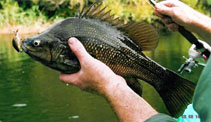
分類 / 名前
共通名の | 類義語 | Catalog of Fishes(部類, 種) | ITIS | CoL | WoRMS | Cloffa
環境:環境 / 気候帯 / 深さの範囲 / 分布範囲
生態学
; 新鮮な水 底生の漂泳性; potamodromous (Ref. 51243); 深さの範囲 0 - 4 m. Temperate; 4°C - 25°C (Ref. 2060); 34°S - 37°S
Oceania: Once widely distributed in the Murray-Darling basin and southeastern coastal drainages. Now reduced to cooler upper reaches of Murray-Darling basin, New South Wales, Australia. Introduced in the Wannon, Barwon, Yarra Rivers (Victoria) and the Nepean and Shoalhaven Rivers (New South Wales), Australia.
初回成熟時の長さ / サイズ / 重さ / 年齢
成熟: Lm ? range ? - 30 cm
Max length : 46.0 cm SL オス/雌雄の選別がない; (Ref. 44894); common length : 23.0 cm SL オス/雌雄の選別がない; (Ref. 5259); 最大公表体重: 3.5 kg (Ref. 2906)
背面の脊椎 (合計) : 8 - 12; 背鰭 (合計) : 12 - 15; 肛門の骨: 3; 臀鰭: 8 - 11; 脊つい: 28 - 31.
Body shape (shape guide): short and / or deep.
Occurs in lakes and flowing streams usually in deep holes with rock or gravel substrates (Ref. 5259). Inhabits cool, clear water of rivers, lakes and reservoirs. Prefers slow-flowing, deep rocky pools. Solitary, swimming near the bottom or in mid-water, but form small shoals during the spawning season (October to December) (Ref. 44894). Forms large shoals near shore. Fry feeds on zooplankton; adult on aquatic insects, crustaceans and mollusks. Male matures at 20 cm (2 y), female at 30 cm (3 y). Spawns upstream in spring or early summer; eggs hatch in 13-18 days; larvae of 7 cm TL (Ref. 5259). Moves into areas just upstream of shallow riffles over gravel or rocky bottoms to spawn. The female releases demersal eggs which sink into cracks in the substrate. Fish in reservoirs move into flowing feeder streams to spawn. Sexual maturity is reached after 2 years (20 centimeters) for males, 3 years (30 centimeters) for females (Ref. 44894). Tolerates temp. down to 9°C (Ref. 7276). Infected by nematodes and copepod Lernaea cyprinacea (Ref. 7315).
ライフサイクルと交尾行動
成熟 | 繁殖 | 放精 | 卵 | 生産力 | 幼生
Return to same river or lake site to spawn each year. Sexually segregated schools (uniform size & age-bet. 4-10 y) migrate upstream: female groups some days or weeks in advance. Most abundant in lakes fed by suitable shallow streams with rock or gravel substrates. Male nudges female vent region; eggs released, fertilized. Eggs turn transparent, increase to 4.0 mm diameter, are spherical, adhesive and demersal and are swept downstream lodging in boulders and pebbles. Hatching in 10-18 days (11-18°C). Larvae shelter in boulders.
Paxton, J.R., D.F. Hoese, G.R. Allen and J.E. Hanley, 1989. Pisces. Petromyzontidae to Carangidae. Zoological Catalogue of Australia, Vol. 7. Australian Government Publishing Service, Canberra, 665 p. (Ref. 7300)
IUCNのレッドリストの状況は (Ref. 130435: Version 2025-2 (Global))
絶滅危惧 (EN) (A2ce; B2ab(ii,iii,iv)); Date assessed: 11 February 2019
人間の用途
水産業: 商業; 水産養殖: 商業; ゲームフィッシュ: はい; 水族館・水槽: 商業
用具
特記事項
XMLをダウンロードして下さい
インターネットの情報源
モデルに基づく推定値
系統多様性指数 (参照
82804): PD
50 = 0.7500 [Uniqueness, from 0.5 = low to 2.0 = high].
Bayesian length-weight: a=0.01738 (0.00677 - 0.04463), b=3.06 (2.83 - 3.29), in cm total length, based on LWR estimates for this (Sub)family-body shape (Ref.
93245).
栄養段階 (参照
69278): 3.3 ±0.01 se; based on food items.
回復力 (参照
120179): 手段, 1.4年~4.4年の倍増期間の最小個体群 (tm=2-3).
漁業の脆弱性 (Ref.
59153): Moderate vulnerability (42 of 100).
🛈