>
Clupeiformes (Herrings) >
Dorosomatidae (Gizzard shads and sardinellas)
Etymology: Sardinella: Latin and Greek, sarda = sardine; name related to the island of Sardinia; diminutive (Ref. 45335).
More on author: Valenciennes.
Ambiente: milieu / zona climática / intervalo de profundidade / gama de distribuição
Ecologia
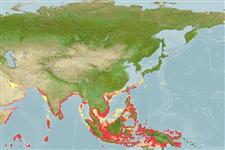
marinhas; estuarina pelagic-neritic; intervalo de profundidade 0 - 50 m (Ref. 188). Tropical; 30°N - 11°S, 47°E - 153°E (Ref. 188)
Indo-West Pacific: from Kuwait to southern India and Bay of Bengal to the Philippines, also eastern tip of Papua New Guinea. Often confused with Sardinella gibbosa in Indian waters.
Comprimento na primeira maturidade / Tamanho / Peso / Idade
Maturidade: Lm 12.3, range 10 - ? cm
Max length : 19.0 cm TL macho/indeterminado; (Ref. 2178); common length : 11.0 cm SL macho/indeterminado; (Ref. 188)
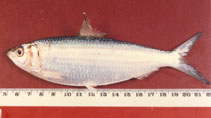
Espinhos dorsais (total) : 0; Raios dorsais moles (total) : 18 - 19; Espinhos anais: 0; Raios anais moles: 18 - 20. This species is distinguished by the following characters: deep body, its depth 28·0-33·2% SL; interrupted longitudinal striae formation in lateral scales; scutes prepelvic and post-pelvic 17-18 + 11-12, respectively, oftern 18 + 12; A 18-20 rays, usually 19; lower gill rakers 65-81 (Ref. 114969).
Body shape (shape guide): fusiform / normal; Cross section: compressed.
Forms schools in coastal waters. Misidentifications (especially with S. gibbosa in Indian waters and S. albella in the western Indian Ocean) make published biological data potentially unreliable. Marketed fresh, dried-salted, boiled or made into fish balls.
Whitehead, P.J.P., 1985. FAO Species Catalogue. Vol. 7. Clupeoid fishes of the world (suborder Clupeoidei). An annotated and illustrated catalogue of the herrings, sardines, pilchards, sprats, shads, anchovies and wolf-herrings. FAO Fish. Synop. 125(7/1):1-303. Rome: FAO. (Ref. 188)
Categoria na Lista Vermelha da IUCN (Ref. 130435: Version 2025-2 (Global))
Ameaça para o homem
Harmless
Utilização humana
Pescarias: espécies comerciais
Ferramentas
Relatórios especiais
Descarregue XML
Fontes da internet
Estimativas baseadas em modelos
Temperatura preferida (Ref.
123201): 27.5 - 29.2, mean 28.6 °C (based on 862 cells).
Índice de diversidade filogenética (Ref.
82804): PD
50 = 0.5000 [Uniqueness, from 0.5 = low to 2.0 = high].
Bayesian length-weight: a=0.00741 (0.00615 - 0.00893), b=3.04 (3.01 - 3.07), in cm total length, based on LWR estimates for this species (Ref.
93245).
Nível Trófico (Ref.
69278): 3.2 ±0.34 se; based on food items.
Generation time: 1.1 (0.9 - 1.2) years. Estimated as median ln(3)/K based on 19
growth studies.
Resiliência (Ref.
120179): Elevada, tempo mínimo de duplicação da população menor que 15 meses (K=0.7-1.6; tmax=3).
Prior r = 0.84, 95% CL = 0.56 - 1.26, Based on 1 data-limited stock assessment.
Vulnerabilidade da pesca (Ref.
59153): Low vulnerability (10 of 100).
🛈
Vulnerabilidade climática (Ref.
125649): Moderate to high vulnerability (53 of 100).
🛈
Nutrientes (Ref.
124155): Calcium = 426 [251, 679] mg/100g; Iron = 2.7 [1.7, 4.3] mg/100g; Protein = 20.6 [19.7, 21.5] %; Omega3 = 0.318 [0.165, 0.607] g/100g; Selenium = 106 [55, 204] μg/100g; VitaminA = 19.9 [8.0, 50.8] μg/100g; Zinc = 2.01 [1.49, 2.67] mg/100g (wet weight); based on
nutrient studies.