>
Beloniformes (Needle fishes) >
Belonidae (Needlefishes)
Etymology: Strongylura: Greek, strongylos = round + Greek, oura = tail (Ref. 45335).
More on author: Walbaum.
Môi trường: môi trường / vùng khí hậu / Mức độ sâu / phạm vi phân phối
Sinh thái học
biển; nước ngọt; thuộc về nước lợ cùng sống ở rạn san hô; mức độ sâu 1 - 3 m (Ref. 58047). Subtropical
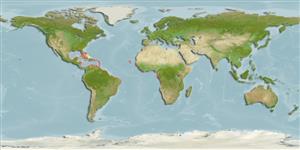
Western Atlantic: southeastern Florida (USA), Bahamas, and northeastern Gulf of Mexico to Brazil.
Bộ gần gũi / Khối lượng (Trọng lượng) / Tuổi
Chín muồi sinh dục: Lm ? range ? - ? cm
Max length : 61.0 cm TL con đực/không giới tính; (Ref. 7251); common length : 35.0 cm TL con đực/không giới tính; (Ref. 5217)
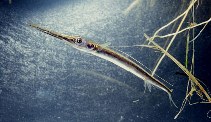
Các vây lưng mềm (tổng cộng) : 15 - 17; Tia mềm vây hậu môn: 16 - 20. Caudal peduncle without a lateral keel, the least depth about equal to the width; maxilla exposed posteriorly; opercles scaled.
Body shape (shape guide): elongated.
Adults found on reef flats, in lagoons, or in freshwater (Ref. 9710). Juveniles found among floating algae (Ref. 9710). Feeds mainly on small fishes (Ref. 3129). Oviparous (Ref. 205). Eggs may be found attached to objects in the water by tendrils on the egg's surface (Ref. 205). During the day preys on small fishes and shrimps close to water surface, approaching potential prey stealthily within lunging range, but when disturbed, may leap and skitter at the surface. At night, young individuals rest close to the surface, aligned with semi-submersed leaves of marsh grass in mangroves, and when disturbed, usually sinks slowly and hides within vegetation. The resemblance to grass blades and its night-time behavior are believed to be defensive adaptations against nocturnal visually oriented predators like night herons (Ref. 40403).
Vòng đời và hành vi giao phối
Chín muồi sinh dục | Sự tái sinh sản | Đẻ trứng | Các trứng | Sự sinh sản | Ấu trùng
Robins, C.R. and G.C. Ray, 1986. A field guide to Atlantic coast fishes of North America. Houghton Mifflin Company, Boston, U.S.A. 354 p. (Ref. 7251)
Tình trạng Sách đỏ IUCN (Ref. 130435: Version 2025-2 (Global))
Mối đe dọa đối với con người
Harmless
Sử dụng của con người
Các nghề cá: các nghề cá là sinh kế
Các công cụ
Báo cáo đặc biệt
Tải xuống XML
Các nguồn internet
Ước tính dựa trên mô hình
Nhiệt độ ưa thích (Tài liệu tham khảo
123201): 24 - 28.1, mean 27.4 °C (based on 778 cells).
Chỉ số đa dạng phát sinh loài (Tài liệu tham khảo
82804): PD
50 = 0.5000 [Uniqueness, from 0.5 = low to 2.0 = high].
Bayesian length-weight: a=0.00166 (0.00106 - 0.00260), b=3.10 (2.97 - 3.23), in cm total length, based on LWR estimates for this species & Genus-body shape (Ref.
93245).
Mức dinh dưỡng (Tài liệu tham khảo
69278): 4.5 ±0.8 se; based on diet studies.
Thích nghi nhanh (Tài liệu tham khảo
120179): Chiêù cao, thời gian nhân đôi của chủng quần tối thiểu là dưới 15 tháng (Preliminary K or Fecundity.).
Sự dễ bị tổn thương của nghề đánh cá (Ref.
59153): Moderate vulnerability (44 of 100).
🛈
Chất dinh dưỡng (Ref.
124155): Calcium = 49.4 [13.5, 197.1] mg/100g; Iron = 0.524 [0.222, 1.285] mg/100g; Protein = 18.3 [16.3, 20.4] %; Omega3 = 0.18 [0.07, 0.52] g/100g; Selenium = 9.41 [3.63, 24.67] μg/100g; VitaminA = 95.1 [23.1, 447.0] μg/100g; Zinc = 0.693 [0.394, 1.211] mg/100g (wet weight);