>
Beloniformes (Needle fishes) >
Belonidae (Needlefishes)
Etymology: Strongylura: Greek, strongylos = round + Greek, oura = tail (Ref. 45335).
More on author: Walbaum.
Entorno: milieu / zona climática / rango de profundidad / gama de distribución
Ecología
marino; agua dulce; salobre asociado a arrecife; rango de profundidad 1 - 3 m (Ref. 58047). Subtropical
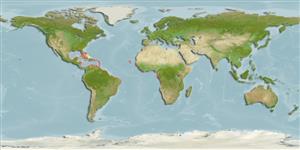
Western Atlantic: southeastern Florida (USA), Bahamas, and northeastern Gulf of Mexico to Brazil.
Tamaño / Peso / Edad
Madurez: Lm ? range ? - ? cm
Max length : 61.0 cm TL macho / no sexado; (Ref. 7251); common length : 35.0 cm TL macho / no sexado; (Ref. 5217)
Radios blandos dorsales (total) : 15 - 17; Radios blandos anales: 16 - 20. Caudal peduncle without a lateral keel, the least depth about equal to the width; maxilla exposed posteriorly; opercles scaled.
Body shape (shape guide): elongated.
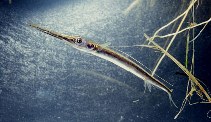
Adults found on reef flats, in lagoons, or in freshwater (Ref. 9710). Juveniles found among floating algae (Ref. 9710). Feeds mainly on small fishes (Ref. 3129). Oviparous (Ref. 205). Eggs may be found attached to objects in the water by tendrils on the egg's surface (Ref. 205). During the day preys on small fishes and shrimps close to water surface, approaching potential prey stealthily within lunging range, but when disturbed, may leap and skitter at the surface. At night, young individuals rest close to the surface, aligned with semi-submersed leaves of marsh grass in mangroves, and when disturbed, usually sinks slowly and hides within vegetation. The resemblance to grass blades and its night-time behavior are believed to be defensive adaptations against nocturnal visually oriented predators like night herons (Ref. 40403).
Ciclo vital y comportamiento de apareamiento
Madurez | Reproducción | Puesta | Huevos | Fecundidad | Larva
Robins, C.R. and G.C. Ray, 1986. A field guide to Atlantic coast fishes of North America. Houghton Mifflin Company, Boston, U.S.A. 354 p. (Ref. 7251)
Situación en la Lista Roja de la UICN (Ref. 130435: Version 2025-2 (Global))
Amenaza para el ser humano
Harmless
Usos humanos
Pesquerías: pesquerías de subsistencia
Herramientas
Informes especiales
Descargar XML
Fuentes de Internet
Estimaciones basadas en modelos
Temperatura preferida (Referencia
123201): 24 - 28.1, mean 27.4 °C (based on 778 cells).
Índice de diversidad filogenética (Referencia
82804): PD
50 = 0.5000 [Uniqueness, from 0.5 = low to 2.0 = high].
Bayesian length-weight: a=0.00166 (0.00106 - 0.00260), b=3.10 (2.97 - 3.23), in cm total length, based on LWR estimates for this species & Genus-body shape (Ref.
93245).
Nivel trófico (Referencia
69278): 4.5 ±0.8 se; based on diet studies.
Resiliencia (Referencia
120179): Alto, población duplicada en un tiempo mínimo inferior a 15 meses (Preliminary K or Fecundity.).
Vulnerabilidad pesquera (Ref.
59153): Moderate vulnerability (44 of 100).
🛈
Nutrientes (Ref.
124155): Calcium = 49.4 [13.5, 197.1] mg/100g; Iron = 0.524 [0.222, 1.285] mg/100g; Protein = 18.3 [16.3, 20.4] %; Omega3 = 0.18 [0.07, 0.52] g/100g; Selenium = 9.41 [3.63, 24.67] μg/100g; VitaminA = 95.1 [23.1, 447.0] μg/100g; Zinc = 0.693 [0.394, 1.211] mg/100g (wet weight);