>
Siluriformes (Catfishes) >
Ariidae (Sea catfishes) > Ariinae
Etymology: Cathorops: Greek, kathorao = to observe, to watch + Greek, ops = appearance (Ref. 45335); spixii: The name is dedicated to the ichthyologist of the 19th century, J.B. de Spix (Ref. 35381).
Eponymy: Johann Baptist Ritter von Spix (1781–1826) was a German naturalist working in Brazil (1817–1820). [...] (Ref. 128868), visit book page.
More on author: Agassiz.
Taxonomic Remarks
Taylor & Menezes (1977) indicate that two or more species may be included here.
Entorno: milieu / zona climática / rango de profundidad / gama de distribución
Ecología
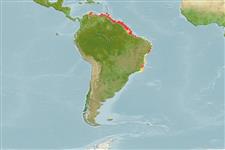
marino; salobre demersal; rango de profundidad 1 - 50 m (Ref. 5217). Tropical; 13°N - 23°S, 77°W - 34°W
Western Atlantic: Atlantic and Caribbean rivers and estuaries from Colombia to Brazil.
Longitud en la primera madurez / Tamaño / Peso / Edad
Madurez: Lm 16.4, range 10 - 22.4 cm
Max length : 30.0 cm TL macho / no sexado; (Ref. 3265); common length : 20.0 cm TL macho / no sexado; (Ref. 3265); peso máximo publicado: 97.50 g (Ref. 118626)
Descripción breve
Claves de identificación | Morfología | Morfometría
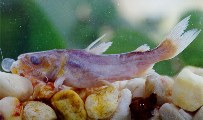
3 pairs of barbels on rostral region, 2 pairs on lower jaw, 1 pair on posterior end of maxilla; body dark brown or black dorsally, pale yellow ventrally; fin membranes brown, with small black spots (Ref. 13608). Head is widely flattened from above, nostril rounded, mouth inferior. The cephalic surface hardly reaches the level of the eyes (Ref. 35381).
Body shape (shape guide): fusiform / normal.
Found in shallow coastal marine waters and brackish estuaries, lagoons and river mouths. Also in hypersaline waters (Ref. 5217). Feeds mainly on invertebrates and small fishes. Juveniles feed on amphipods, isopods and copepods (Ref. 35381). Flesh considered good quality (Ref. 5217). Sold locally.
Ciclo vital y comportamiento de apareamiento
Madurez | Reproducción | Puesta | Huevos | Fecundidad | Larva
Marceniuk, A.P. and C.J. Ferraris Jr., 2003. Ariidae (Sea catfishes). p. 447-455. In R.E. Reis, S.O. Kullander and C.J. Ferraris, Jr. (eds.) Checklist of the freshwater fishes of South and Central America. Porto Alegre: EDIPUCRS, Brasil. (Ref. 39852)
Situación en la Lista Roja de la UICN (Ref. 130435: Version 2025-2 (Global))
Amenaza para el ser humano
Traumatogenic (Ref. 58010)
Usos humanos
Pesquerías: escaso valor comercial
Herramientas
Informes especiales
Descargar XML
Fuentes de Internet
Estimaciones basadas en modelos
Temperatura preferida (Referencia
123201): 24.9 - 28.2, mean 27.4 °C (based on 118 cells).
Índice de diversidad filogenética (Referencia
82804): PD
50 = 0.5000 [Uniqueness, from 0.5 = low to 2.0 = high].
Bayesian length-weight: a=0.00661 (0.00548 - 0.00797), b=3.06 (3.02 - 3.10), in cm total length, based on LWR estimates for this species (Ref.
93245).
Nivel trófico (Referencia
69278): 3.5 ±0.1 se; based on diet studies.
Resiliencia (Referencia
120179): Alto, población duplicada en un tiempo mínimo inferior a 15 meses (Preliminary K or Fecundity.).
Vulnerabilidad pesquera (Ref.
59153): Low vulnerability (20 of 100).
🛈
Nutrientes (Ref.
124155): Calcium = 122 [59, 299] mg/100g; Iron = 1 [1, 2] mg/100g; Protein = 17 [15, 19] %; Omega3 = 0.267 [0.142, 0.513] g/100g; Selenium = 44.3 [21.0, 99.1] μg/100g; VitaminA = 37.5 [12.6, 116.5] μg/100g; Zinc = 1.71 [1.12, 2.74] mg/100g (wet weight);