>
Siluriformes (Catfishes) >
Ariidae (Sea catfishes) > Ariinae
Etymology: Cathorops: Greek, kathorao = to observe, to watch + Greek, ops = appearance (Ref. 45335); spixii: The name is dedicated to the ichthyologist of the 19th century, J.B. de Spix (Ref. 35381).
Eponymy: Johann Baptist Ritter von Spix (1781–1826) was a German naturalist working in Brazil (1817–1820). [...] (Ref. 128868), visit book page.
More on author: Agassiz.
Taxonomic Remarks
Taylor & Menezes (1977) indicate that two or more species may be included here.
Περιβάλλον: περιβάλλον / κλιματική ζώνη / εύρος βάθους / εύρος διανομής
Οικολογία
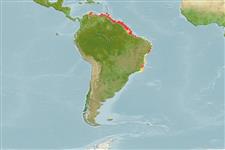
Θαλασσινό(ά); Υφάλμυρο βενθικό(ς); εύρος βάθους 1 - 50 m (Ref. 5217). Tropical; 13°N - 23°S, 77°W - 34°W
Western Atlantic: Atlantic and Caribbean rivers and estuaries from Colombia to Brazil.
Μήκος κατά την πρώτη ωρίμανση / Μέγεθος / Βάρος / Ηλικία
Γεννητική Ωρίμανση: Lm 16.4, range 10 - 22.4 cm
Max length : 30.0 cm TL αρσενικό/απροσδιόριστο; (Ref. 3265); common length : 20.0 cm TL αρσενικό/απροσδιόριστο; (Ref. 3265); μεγ. δημοσιευμένο βάρος: 97.50 g (Ref. 118626)
Σύντομη περιγραφή
Κλείδες προσδιορισμού | Μορφολογία | Μορφομετρία
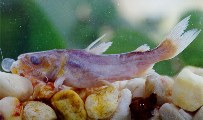
3 pairs of barbels on rostral region, 2 pairs on lower jaw, 1 pair on posterior end of maxilla; body dark brown or black dorsally, pale yellow ventrally; fin membranes brown, with small black spots (Ref. 13608). Head is widely flattened from above, nostril rounded, mouth inferior. The cephalic surface hardly reaches the level of the eyes (Ref. 35381).
Body shape (shape guide): fusiform / normal.
Found in shallow coastal marine waters and brackish estuaries, lagoons and river mouths. Also in hypersaline waters (Ref. 5217). Feeds mainly on invertebrates and small fishes. Juveniles feed on amphipods, isopods and copepods (Ref. 35381). Flesh considered good quality (Ref. 5217). Sold locally.
Κύκλος ζωής και συμπεριφορά ζευγαρώματος
Γεννητική Ωρίμανση | Αναπαραγωγή | Γεννοβολία | Αβγά | Γονιμότητα | Προνύμφες
Marceniuk, A.P. and C.J. Ferraris Jr., 2003. Ariidae (Sea catfishes). p. 447-455. In R.E. Reis, S.O. Kullander and C.J. Ferraris, Jr. (eds.) Checklist of the freshwater fishes of South and Central America. Porto Alegre: EDIPUCRS, Brasil. (Ref. 39852)
Κατάσταση Κόκκινου Καταλόγου IUCN (Ref. 130435: Version 2025-2 (Global))
Απειλή για τον άνθρωπο
Traumatogenic (Ref. 58010)
Ανθρώπινες χρήσεις
αλιεία: περιορισμένης εμπορικότητας
Εργαλεία
Ειδικές εκθέσεις
Λήψη XML
Διαδικτυακές πηγές
Εκτιμήσεις βάσει μοντέλων
Προτιμώμενη θερμοκρασία (Αναφ.
123201): 24.9 - 28.2, mean 27.4 °C (based on 118 cells).
Δείκτης φυλογενετικής ποικιλότητας (Αναφ.
82804): PD
50 = 0.5000 [Uniqueness, from 0.5 = low to 2.0 = high].
Bayesian length-weight: a=0.00661 (0.00548 - 0.00797), b=3.06 (3.02 - 3.10), in cm total length, based on LWR estimates for this species (Ref.
93245).
Τροφικό Επίπεδο (Αναφ.
69278): 3.5 ±0.1 se; based on diet studies.
Ελαστικότητα (Αναφ.
120179): Υψηλό, ελάχιστος χρόνος για διπλασιασμό πληθυσμού < 15 μήνες (Preliminary K or Fecundity.).
Ευπάθεια στην αλιεία (Ref.
59153): Low vulnerability (20 of 100).
🛈
Θρεπτικά συστατικά (Ref.
124155): Calcium = 122 [59, 299] mg/100g; Iron = 1 [1, 2] mg/100g; Protein = 17 [15, 19] %; Omega3 = 0.267 [0.142, 0.513] g/100g; Selenium = 44.3 [21.0, 99.1] μg/100g; VitaminA = 37.5 [12.6, 116.5] μg/100g; Zinc = 1.71 [1.12, 2.74] mg/100g (wet weight);