>
Petromyzontiformes (Lampreys) >
Petromyzontidae (Northern lampreys) > Lampetrinae
Etymology: Entosphenus: entos (Gr.), within; sphenos (Gr.), wedge, referring to wedge-shaped tooth within mouth on tongue of E. tridentatus (See ETYFish); similis: Latin for like or resembling, referring to similarity to E. tridentatus (See ETYFish).
Môi trường: môi trường / vùng khí hậu / Mức độ sâu / phạm vi phân phối
Sinh thái học
; nước ngọt gần đáy; di cư trong nước ngọt (Ref. 126106). Temperate; 43°N - 41°N
North America: Klamath River drainage and Klamath Lake in southern Oregon and northern California in USA.
Bộ gần gũi / Khối lượng (Trọng lượng) / Tuổi
Chín muồi sinh dục: Lm ? range ? - ? cm
Max length : 27.0 cm TL con đực/không giới tính; (Ref. 5723); common length : 19.2 cm TL con đực/không giới tính; (Ref. 12193)
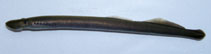
Adults: 13.6-26.9 cm TL. Adult body proportions, as percentage of TL (based on 29 specimens measuring 13.6-26.9 cm TL): prebranchial length, 13.0-16.4; branchial length, 8.2-11.8; trunk length, 42.5-52.0; tail length, 27.0-34.9; eye length, 1.4-2.7; disc length, 7.8-10.5. The intestinal diameter in feeding individuals is 0.45 cm. Trunk myomeres, 58-65. Dentition: the marginals in the anterior and lateral fields are of two different sizes, small and with an elongated base, while those in the posterior field are small; exceptionally, one or two of these elongate marginals on each side lie in the middle of the lateral fields and therefore qualify as exolaterals; supraoral lamina, 3 unicuspid teeth, the median one smaller than the lateral ones; infraoral lamina, 5-6 unicuspid teeth, predominantly 5; 4 endolaterals on each side, rarely 3 on one side; endolateral formula, typically 2-3-3-2, the second endolateral may also be uni-, bi- or quadricuspid, the third endolateral may also be quadricuspid, and the fourth endolateral may be absent, but if present, also be uni-, bi- or quadricuspid; 2 rows of anterials; first row of anterials, 4-5 unicuspid teeth; exolaterals not present as rows but 1 or 2 on each side may be present; 1 row of posterials with 16-20 teeth, of which 0-15 are bicuspid and the rest unicuspid; transverse lingual lamina, 20-29 unicuspid teeth, the median one slightly enlarged; longitudinal lingual laminae each with 24-33 unicuspid teeth. Velar tentacles, 7-9, with tubercles and wings consisting of a very short tentacle on either side. Median tentacle shorter than the lateral ones immediately next to it. Body coloration (preserved), dark brown on dorsal, lateral, and ventral aspects. Lateral line neuromasts darkly pigmented. Caudal fin and second dorsal fin pigmentation, coverage of 75% or more. Caudal fin shape, spade-like. Oral fimbriae, 98-111. Oral papillae, 12-20.
Body shape (shape guide): eel-like.
Adults occur in large rivers, impoundments and lakes. Parasitic (Ref. 5723). Known to feed on fishes perhaps of commercial importance, but these were not identified (Ref. 89241).
Vòng đời và hành vi giao phối
Chín muồi sinh dục | Sự tái sinh sản | Đẻ trứng | Các trứng | Sự sinh sản | Ấu trùng
Page, L.M. and B.M. Burr, 1991. A field guide to freshwater fishes of North America north of Mexico. Houghton Mifflin Company, Boston. 432 p. (Ref. 5723)
Tình trạng Sách đỏ IUCN (Ref. 130435: Version 2025-2 (Global))
Mối đe dọa đối với con người
Harmless
Sử dụng của con người
Các nghề cá: không ích lợi (thú vị)
Các công cụ
Báo cáo đặc biệt
Tải xuống XML
Các nguồn internet
Ước tính dựa trên mô hình
Chỉ số đa dạng phát sinh loài (Tài liệu tham khảo
82804): PD
50 = 0.5156 [Uniqueness, from 0.5 = low to 2.0 = high].
Bayesian length-weight: a=0.00132 (0.00060 - 0.00290), b=2.99 (2.80 - 3.18), in cm total length, based on LWR estimates for this (Sub)family-body shape (Ref.
93245).
Mức dinh dưỡng (Tài liệu tham khảo
69278): 4.2 ±0.73 se; based on food items.
Thích nghi nhanh (Tài liệu tham khảo
120179): thấp, thời gian nhân đôi của chủng quần tối thiểu là 4.5 - 14 năm (Preliminary K or Fecundity.).
Sự dễ bị tổn thương của nghề đánh cá (Ref.
59153): Low vulnerability (17 of 100).
🛈