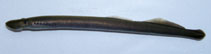
Classificazione / Nomi
Nomi Comuni | Sinonimi | Catalog of Fishes(Genere, Specie) | ITIS | CoL | WoRMS | Cloffa
>
Petromyzontiformes (Lampreys) >
Petromyzontidae (Northern lampreys) > Lampetrinae
Etymology: Entosphenus: entos (Gr.), within; sphenos (Gr.), wedge, referring to wedge-shaped tooth within mouth on tongue of E. tridentatus (See ETYFish); similis: Latin for like or resembling, referring to similarity to E. tridentatus (See ETYFish).
Ambiente: milieu / zona climatica / distribuzione batimetrica / gamma di distribuzione
Ecologia
; acqua dolce demersale; potamodromo (Ref. 126106). Temperate; 43°N - 41°N
North America: Klamath River drainage and Klamath Lake in southern Oregon and northern California in USA.
Dimensione / Peso / Età
Maturità: Lm ? range ? - ? cm
Max length : 27.0 cm TL maschio/sesso non determinato; (Ref. 5723); common length : 19.2 cm TL maschio/sesso non determinato; (Ref. 12193)
Adults: 13.6-26.9 cm TL. Adult body proportions, as percentage of TL (based on 29 specimens measuring 13.6-26.9 cm TL): prebranchial length, 13.0-16.4; branchial length, 8.2-11.8; trunk length, 42.5-52.0; tail length, 27.0-34.9; eye length, 1.4-2.7; disc length, 7.8-10.5. The intestinal diameter in feeding individuals is 0.45 cm. Trunk myomeres, 58-65. Dentition: the marginals in the anterior and lateral fields are of two different sizes, small and with an elongated base, while those in the posterior field are small; exceptionally, one or two of these elongate marginals on each side lie in the middle of the lateral fields and therefore qualify as exolaterals; supraoral lamina, 3 unicuspid teeth, the median one smaller than the lateral ones; infraoral lamina, 5-6 unicuspid teeth, predominantly 5; 4 endolaterals on each side, rarely 3 on one side; endolateral formula, typically 2-3-3-2, the second endolateral may also be uni-, bi- or quadricuspid, the third endolateral may also be quadricuspid, and the fourth endolateral may be absent, but if present, also be uni-, bi- or quadricuspid; 2 rows of anterials; first row of anterials, 4-5 unicuspid teeth; exolaterals not present as rows but 1 or 2 on each side may be present; 1 row of posterials with 16-20 teeth, of which 0-15 are bicuspid and the rest unicuspid; transverse lingual lamina, 20-29 unicuspid teeth, the median one slightly enlarged; longitudinal lingual laminae each with 24-33 unicuspid teeth. Velar tentacles, 7-9, with tubercles and wings consisting of a very short tentacle on either side. Median tentacle shorter than the lateral ones immediately next to it. Body coloration (preserved), dark brown on dorsal, lateral, and ventral aspects. Lateral line neuromasts darkly pigmented. Caudal fin and second dorsal fin pigmentation, coverage of 75% or more. Caudal fin shape, spade-like. Oral fimbriae, 98-111. Oral papillae, 12-20.
Body shape (shape guide): eel-like.
Adults occur in large rivers, impoundments and lakes. Parasitic (Ref. 5723). Known to feed on fishes perhaps of commercial importance, but these were not identified (Ref. 89241).
Ciclo vitale e comportamento di accoppiamento
Maturità | Riproduzione | Deposizione | Uova | Fecondità | Larve
Page, L.M. and B.M. Burr, 1991. A field guide to freshwater fishes of North America north of Mexico. Houghton Mifflin Company, Boston. 432 p. (Ref. 5723)
Stato della Lista Rossa IUCN (Ref. 130435: Version 2025-2 (Global))
Minaccia per l'uomo
Harmless
Usi umani
Pesca: di nessun interesse
Strumenti
Rapporti speciali
Scarica XML
Fonti Internet
Stime basate su modelli
Indice di diversità filogenetica (Fonte Biblio.
82804): PD
50 = 0.5156 [Uniqueness, from 0.5 = low to 2.0 = high].
Bayesian length-weight: a=0.00132 (0.00060 - 0.00290), b=2.99 (2.80 - 3.18), in cm total length, based on LWR estimates for this (Sub)family-body shape (Ref.
93245).
Livello trofico (Fonte Biblio.
69278): 4.2 ±0.73 se; based on food items.
Resilienza (Fonte Biblio.
120179): Basso, tempo minimo di raddoppiamento della popolazione 4.5 - 14 anni (Preliminary K or Fecundity.).
Vulnerabilità della pesca (Ref.
59153): Low vulnerability (17 of 100).
🛈