>
Acanthuriformes (Surgeonfishes) >
Acanthuridae (Surgeonfishes, tangs, unicornfishes) > Acanthurinae
Etymology: Acanthurus: Greek, akantha = thorn + Greek, oura = tail (Ref. 45335).
More on author: Bloch.
Ambiente: milieu / zona climatica / distribuzione batimetrica / gamma di distribuzione
Ecologia
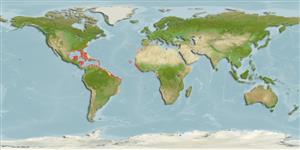
marino associati a barriera corallina; distribuzione batimetrica 2 - 25 m (Ref. 7345), usually 2 - 15 m (Ref. 27115). Subtropical; 22°C - 25°C (Ref. 27115); 43°N - 30°S, 98°W - 5°W (Ref. 55164)
Western Atlantic: Massachusetts (USA), Bermuda, and the northern Gulf of Mexico to São Paulo, Brazil. Eastern Atlantic: Senegal and Ascension Is.
Lunghezza alla prima maturità / Dimensione / Peso / Età
Maturità: Lm ?, range 17 - ? cm
Max length : 39.0 cm TL maschio/sesso non determinato; (Ref. 47377); common length : 35.0 cm TL maschio/sesso non determinato; (Ref. 5217); peso massimo pubblicato: 5.1 kg (Ref. 40637)
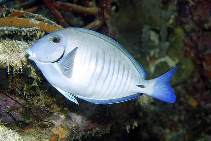
Spine dorsali (totale) : 9; Raggi dorsali molli (totale) : 24 - 25; Spine anali: 3; Raggi anali molli: 22 - 23. Caudal fin slightly emarginate (Ref. 13442). Body gray, with 10 well-spaced, narrow, darker gray vertical bars on side (Ref. 26938).
Body shape (shape guide): short and / or deep.
Inhabits shallow reefs or rocky areas. Found in loose aggregations (Ref. 9710). Mainly diurnal. Ingests sand when feeding on algae (Ref. 13442). The spine on both sides of the caudal peduncle may inflict painful wounds (Ref. 5217). Minimum depth reported from Ref. 27115. Larvae are planktonic (Ref. 47377). At Fernando de Noronha Archipelago in southwestern Atlantic, juveniles hold cleaning stations together with the blue tang (Acanthurus coeruleus) and sergeant major (Abudefduf saxatilis) and graze algae as well as pick molted skin and parasites from green turtles (Chelonia mydas). This behavior is preceded by a characteristic inspection usually followed by feeding nips on the turtles’ skin (head, limbs, and tail), as well as on the carapace. The most inspected and cleaned body parts are the flippers (Ref. 51385).
Ciclo vitale e comportamento di accoppiamento
Maturità | Riproduzione | Deposizione | Uova | Fecondità | Larve
Robins, C.R. and G.C. Ray, 1986. A field guide to Atlantic coast fishes of North America. Houghton Mifflin Company, Boston, U.S.A. 354 p. (Ref. 7251)
Stato della Lista Rossa IUCN (Ref. 130435: Version 2025-2 (Global))
Minaccia per l'uomo
Traumatogenic (Ref. 5217)
Usi umani
Pesca: scarso interesse commerciale; Pesce da pesca sportiva: si; Acquario: Commerciale
Strumenti
Rapporti speciali
Scarica XML
Fonti Internet
Stime basate su modelli
Temperatura preferita (Fonte Biblio.
123201): 26.1 - 28, mean 27.4 °C (based on 769 cells).
Indice di diversità filogenetica (Fonte Biblio.
82804): PD
50 = 0.5000 [Uniqueness, from 0.5 = low to 2.0 = high].
Bayesian length-weight: a=0.02188 (0.01816 - 0.02636), b=2.96 (2.92 - 3.00), in cm total length, based on LWR estimates for this species (Ref.
93245).
Livello trofico (Fonte Biblio.
69278): 2.1 ±0.1 se; based on diet studies.
Resilienza (Fonte Biblio.
120179): Medio, tempo minimo di raddoppiamento della popolazione 1.4 - 4.4 anni (K=0.25-0.50).
Vulnerabilità della pesca (Ref.
59153): Low vulnerability (23 of 100).
🛈
Nutrienti (Ref.
124155): Calcium = 39.8 [15.6, 133.0] mg/100g; Iron = 0.822 [0.286, 2.182] mg/100g; Protein = 19.1 [17.8, 20.4] %; Omega3 = 0.146 [0.063, 0.347] g/100g; Selenium = 8.83 [2.71, 27.87] μg/100g; VitaminA = 17.5 [3.7, 82.5] μg/100g; Zinc = 1.78 [0.55, 3.61] mg/100g (wet weight);