>
Acanthuriformes (Surgeonfishes) >
Acanthuridae (Surgeonfishes, tangs, unicornfishes) > Acanthurinae
Etymology: Acanthurus: Greek, akantha = thorn + Greek, oura = tail (Ref. 45335).
More on author: Bloch.
Environnement : milieu / zone climatique / profondeur / gamme de distribution
Écologie
marin récifal; profondeur 2 - 25 m (Ref. 7345), usually 2 - 15 m (Ref. 27115). Subtropical; 22°C - 25°C (Ref. 27115); 43°N - 30°S, 98°W - 5°W (Ref. 55164)
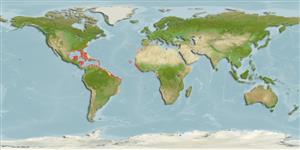
Western Atlantic: Massachusetts (USA), Bermuda, and the northern Gulf of Mexico to São Paulo, Brazil. Eastern Atlantic: Senegal and Ascension Is.
Longueur à la première maturité / Taille / Poids / Âge
Maturité: Lm ?, range 17 - ? cm
Max length : 39.0 cm TL mâle / non sexé; (Ref. 47377); common length : 35.0 cm TL mâle / non sexé; (Ref. 5217); poids max. publié: 5.1 kg (Ref. 40637)
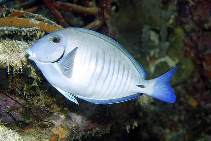
Épines dorsales (Total) : 9; Rayons mous dorsaux (Total) : 24 - 25; Épines anales: 3; Rayons mous anaux: 22 - 23. Caudal fin slightly emarginate (Ref. 13442). Body gray, with 10 well-spaced, narrow, darker gray vertical bars on side (Ref. 26938).
Body shape (shape guide): short and / or deep.
Inhabits shallow reefs or rocky areas. Found in loose aggregations (Ref. 9710). Mainly diurnal. Ingests sand when feeding on algae (Ref. 13442). The spine on both sides of the caudal peduncle may inflict painful wounds (Ref. 5217). Minimum depth reported from Ref. 27115. Larvae are planktonic (Ref. 47377). At Fernando de Noronha Archipelago in southwestern Atlantic, juveniles hold cleaning stations together with the blue tang (Acanthurus coeruleus) and sergeant major (Abudefduf saxatilis) and graze algae as well as pick molted skin and parasites from green turtles (Chelonia mydas). This behavior is preceded by a characteristic inspection usually followed by feeding nips on the turtles’ skin (head, limbs, and tail), as well as on the carapace. The most inspected and cleaned body parts are the flippers (Ref. 51385).
Cycle de vie et comportement reproducteur
Maturité | Reproduction | Frai | Œufs | Fécondité | Larves
Robins, C.R. and G.C. Ray, 1986. A field guide to Atlantic coast fishes of North America. Houghton Mifflin Company, Boston, U.S.A. 354 p. (Ref. 7251)
Statut dans la liste rouge de l'IUCN (Ref. 130435: Version 2025-2 (Global))
Menace pour l'homme
Traumatogenic (Ref. 5217)
Utilisations par l'homme
Pêcheries: intérêt commercial mineur; pêche sportive: oui; Aquarium: Commercial
Outils
Articles particuliers
Télécharger en XML
Sources Internet
Estimations basées sur des modèles
Température préférée (Réf.
123201): 26.1 - 28, mean 27.4 °C (based on 769 cells).
Indice de diversité phylogénétique (Réf.
82804): PD
50 = 0.5000 [Uniqueness, from 0.5 = low to 2.0 = high].
Bayesian length-weight: a=0.02188 (0.01816 - 0.02636), b=2.96 (2.92 - 3.00), in cm total length, based on LWR estimates for this species (Ref.
93245).
Niveau trophique (Réf.
69278): 2.1 ±0.1 se; based on diet studies.
Résilience (Réf.
120179): Milieu, temps minimum de doublement de population : 1,4 à 4,4 années (K=0.25-0.50).
Vulnérabilité de la pêche (Ref.
59153): Low vulnerability (23 of 100).
🛈
Nutriments (Ref.
124155): Calcium = 39.8 [15.6, 133.0] mg/100g; Iron = 0.822 [0.286, 2.182] mg/100g; Protein = 19.1 [17.8, 20.4] %; Omega3 = 0.146 [0.063, 0.347] g/100g; Selenium = 8.83 [2.71, 27.87] μg/100g; VitaminA = 17.5 [3.7, 82.5] μg/100g; Zinc = 1.78 [0.55, 3.61] mg/100g (wet weight);