>
Siluriformes (Catfishes) >
Auchenoglanididae (Flatnose catfishes)
Etymology: Parauchenoglanis: Greek, para = near + Greek, auchen = neck + Greek, glanis = a fish that can eat the bait without touching the hook; a cat fish (Ref. 45335); ngamensis: Named after the country of its type locality, Lake Ngami, Botswana.
More on author: Boulenger.
Môi trường: môi trường / vùng khí hậu / Mức độ sâu / phạm vi phân phối
Sinh thái học
; nước ngọt sống nổi và đáy; pH range: 6.2 - 7.5; dH range: 4 - 25. Tropical; 22°C - 26°C (Ref. 2059)
Africa: Okavango and upper Zambezi (sub)basins): Angola, Botswana, Namibia, and Zambia.
Bộ gần gũi / Khối lượng (Trọng lượng) / Tuổi
Chín muồi sinh dục: Lm ? range ? - ? cm
Max length : 38.0 cm SL con đực/không giới tính; (Ref. 52193)
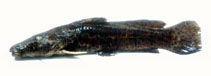
Các vây lưng mềm (tổng cộng) : 7 - 8; Tia mềm vây hậu môn: 8 - 11; Động vật có xương sống: 34 - 36. This species is distinguished from its congeners ahli, altipinnis, balayi, buettikoferi, longiceps, monkei, pantherinus, punctatus by having a broad humeral process (vs. pointed); further differs from altipinnis, balayi, pantherinus, punctatus by having a coarse skin (vs. smooth); further differs from buettikoferi, monkei with the anterior margin of the pectoral-fin spine being mostly smooth (vs. serrated from base to tip); further differs from ahli, punctatus by having shorter barbels, with external mandibular barbel not reaching the distal tip of the pectoral fin (vs. barbels long, with external mandibular barbel reaching distal tip of pectoral fin or beyond); differs from zebratus by the broad humeral process which is clearly visible through the skin and presence of five to seven bars on small specimens (?100 mm SL) and vertical rows of spots on larger-sized specimens (vs. broad humeral process embedded under the skin and four to five vertical rows of spots on small specimens, and bars on larger-sized specimens); differs from stiassnyae by having vertical rows of black spots interspaced by scattered smaller black spots (vs. irregularly scattered large blotches and absence of smaller spots on the flank), and having shorter barbels, external mandibular barbel not reaching the distal tip of the pectoral-fin spine (vs. longer barbels, external mandibular extending beyond tip of the pectoral-fin spine).Parauchenoglanis ngamensis is distinguished from the other members of the P. ngamensis group, i.e. patersoni, dolichorhinus, luendaensis, chiumbeensis, by the presence of scattered black spots in between the vertical rows of black spots (vs. absent); further distinguished from these species by having a heavily spotted head and fins (vs. unspotted head and fins in luendaensis; few black spots or unspotted head and fins in patersoni, dolichorhinus, and head and fins with faint black spots in chiumbeensis); further distinguished from chiumbeensis, luendaensis by having a round caudal fin (vs. truncated); differs from ernstswartzi, megalasma by the vertical rows of black spots (vs. vertical rows of black blotches) and bluntly triangular snout (vs. round in ernstswartzi and partly round in megalasma); differs further from ernstswartzi by the eyes situated dorsolateral (vs. eyes situated dorsally, i.e. high on the head towards its upper edge) and absence of black spots at the base of pectoral fin (vs. present); differs from lueleensis by the presence of numerous black spots in between vertical rows (vs. one or two spots present in between vertical rows); differs from poikilos by having a rounded caudal fin (vs. truncated) and the absence of crescent-shaped marking on the caudal-fin base (vs. presence) (Ref. 132425).
Cross section: oval.
It prfers rocky habitats or marginal vegetation in slow-flowing rivers and lagoons, often taking shelter under trees (Ref. 52193). It feeds on small fishes and invertebrates like snails, shrimps and insects (Ref. 52193). Eggs are large and relatively few, suggesting parental care, but no details are know (Ref. 52193). It 'grunts' when removed from the water (Ref. 7248, 52193).
Vòng đời và hành vi giao phối
Chín muồi sinh dục | Sự tái sinh sản | Đẻ trứng | Các trứng | Sự sinh sản | Ấu trùng
Sithole, Y., E.J.W.M.N. Vreven, P.H.N. Bragança, T. Musschoot and A. Chakona, 2024. Nine in one: integrative taxonomic evidence of hidden species diversity in the widespread Zambezi grunter, Parauchenoglanis ngamensis (Siluriformes: Auchenoglanididae), from southern and south-central Africa. Zool. J. Linn. Soc. 202:1-33. (Ref. 132425)
Tình trạng Sách đỏ IUCN (Ref. 130435: Version 2025-2 (Global))
Mối đe dọa đối với con người
Harmless
Sử dụng của con người
Các nghề cá: buôn bán nhỏ; Bể nuôi cá: Tiềm năng
Các công cụ
Báo cáo đặc biệt
Tải xuống XML
Các nguồn internet
Ước tính dựa trên mô hình
Chỉ số đa dạng phát sinh loài (Tài liệu tham khảo
82804): PD
50 = 0.5000 [Uniqueness, from 0.5 = low to 2.0 = high].
Bayesian length-weight: a=0.00617 (0.00275 - 0.01383), b=3.09 (2.88 - 3.30), in cm total length, based on LWR estimates for this species & (Sub)family-body (Ref.
93245).
Mức dinh dưỡng (Tài liệu tham khảo
69278): 3.6 ±0.58 se; based on food items.
Thích nghi nhanh (Tài liệu tham khảo
120179): Trung bình, thời gian nhân đôi của chủng quần tối thiểu là 1.4 - 4.4 năm (Preliminary K or Fecundity.).
Sự dễ bị tổn thương của nghề đánh cá (Ref.
59153): Moderate vulnerability (36 of 100).
🛈