分類 / 名稱
俗名 | 同種異名 | Catalog of Fishes(屬, 種) | ITIS | CoL | WoRMS | Cloffa
Teleostei >
Siluriformes (Catfishes) >
Auchenoglanididae (Flatnose catfishes)
Etymology: Parauchenoglanis: Greek, para = near + Greek, auchen = neck + Greek, glanis = a fish that can eat the bait without touching the hook; a cat fish (Ref. 45335); ngamensis: Named after the country of its type locality, Lake Ngami, Botswana.
More on author: Boulenger.
環境: 環境 / 氣候帶 / 深度上下限 / 配送範圍
生態學
; 淡水 底中水層性; pH range: 6.2 - 7.5; dH range: 4 - 25. 熱帶; 22°C - 26°C (Ref. 2059)
Africa: Okavango and upper Zambezi (sub)basins): Angola, Botswana, Namibia, and Zambia.
非洲: 奧塔萬戈河, 三比西上游與 Kasai 河流域。
大小 / 重量 / 年齡
成熟度: Lm ? range ? - ? cm
Max length : 38.0 cm SL 雄魚/尚未辨別雌雄; (Ref. 52193)
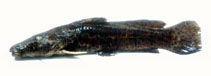
背的軟條 (總數) : 7 - 8; 臀鰭軟條: 8 - 11; 脊椎骨: 34 - 36. This species is distinguished from its congeners ahli, altipinnis, balayi, buettikoferi, longiceps, monkei, pantherinus, punctatus by having a broad humeral process (vs. pointed); further differs from altipinnis, balayi, pantherinus, punctatus by having a coarse skin (vs. smooth); further differs from buettikoferi, monkei with the anterior margin of the pectoral-fin spine being mostly smooth (vs. serrated from base to tip); further differs from ahli, punctatus by having shorter barbels, with external mandibular barbel not reaching the distal tip of the pectoral fin (vs. barbels long, with external mandibular barbel reaching distal tip of pectoral fin or beyond); differs from zebratus by the broad humeral process which is clearly visible through the skin and presence of five to seven bars on small specimens (?100 mm SL) and vertical rows of spots on larger-sized specimens (vs. broad humeral process embedded under the skin and four to five vertical rows of spots on small specimens, and bars on larger-sized specimens); differs from stiassnyae by having vertical rows of black spots interspaced by scattered smaller black spots (vs. irregularly scattered large blotches and absence of smaller spots on the flank), and having shorter barbels, external mandibular barbel not reaching the distal tip of the pectoral-fin spine (vs. longer barbels, external mandibular extending beyond tip of the pectoral-fin spine).Parauchenoglanis ngamensis is distinguished from the other members of the P. ngamensis group, i.e. patersoni, dolichorhinus, luendaensis, chiumbeensis, by the presence of scattered black spots in between the vertical rows of black spots (vs. absent); further distinguished from these species by having a heavily spotted head and fins (vs. unspotted head and fins in luendaensis; few black spots or unspotted head and fins in patersoni, dolichorhinus, and head and fins with faint black spots in chiumbeensis); further distinguished from chiumbeensis, luendaensis by having a round caudal fin (vs. truncated); differs from ernstswartzi, megalasma by the vertical rows of black spots (vs. vertical rows of black blotches) and bluntly triangular snout (vs. round in ernstswartzi and partly round in megalasma); differs further from ernstswartzi by the eyes situated dorsolateral (vs. eyes situated dorsally, i.e. high on the head towards its upper edge) and absence of black spots at the base of pectoral fin (vs. present); differs from lueleensis by the presence of numerous black spots in between vertical rows (vs. one or two spots present in between vertical rows); differs from poikilos by having a rounded caudal fin (vs. truncated) and the absence of crescent-shaped marking on the caudal-fin base (vs. presence) (Ref. 132425).
Cross section: oval.
It prfers rocky habitats or marginal vegetation in slow-flowing rivers and lagoons, often taking shelter under trees (Ref. 52193). It feeds on small fishes and invertebrates like snails, shrimps and insects (Ref. 52193). Eggs are large and relatively few, suggesting parental care, but no details are know (Ref. 52193). It 'grunts' when removed from the water (Ref. 7248, 52193).
在緩慢流動的河川與潟湖中喜歡岩石的棲息地或雜草叢, 時常佔據在樹下面的庇護所。 食物由小魚與像蝸牛,蝦與昆蟲的無脊椎動物組成。 卵是大而相當少見的, 建議親代養育,但是沒有細節已知是。 '石鱸' 當採離開水面.(參考文獻 7248)
生命週期和交配行為
成熟度 | 繁殖 | 產卵場 | 卵 | 孕卵數 | 仔魚
非洲: 奧塔萬戈河, 三比西上游與 Kasai 河流域。
Sithole, Y., E.J.W.M.N. Vreven, P.H.N. Bragança, T. Musschoot and A. Chakona, 2024. Nine in one: integrative taxonomic evidence of hidden species diversity in the widespread Zambezi grunter, Parauchenoglanis ngamensis (Siluriformes: Auchenoglanididae), from southern and south-central Africa. Zool. J. Linn. Soc. 202:1-33. (Ref. 132425)
IUCN 瀕危狀態 (Ref. 130435: Version 2025-2 (Global))
無危 (LC) ; Date assessed: 16 February 2009
人類使用
漁業: 低經濟; 水族館: 潛在的
工具
特別的報告
下載 XML
網路資源
基於模型的估計
系統發育多樣性指數 (參考文獻
82804): PD
50 = 0.5000 [Uniqueness, from 0.5 = low to 2.0 = high].
Bayesian length-weight: a=0.00617 (0.00275 - 0.01383), b=3.09 (2.88 - 3.30), in cm total length, based on LWR estimates for this species & (Sub)family-body (Ref.
93245).
營養階層 (參考文獻
69278): 3.6 ±0.58 se; based on food items.
回復力 (參考文獻
120179): 中等的, 族群倍增時間最少 1.4 - 4.4年 (Preliminary K or Fecundity.).
釣魚的脆弱性 (Ref.
59153): Moderate vulnerability (36 of 100).
🛈