Lớp phụ Cá sụn (cá mập và cá đuối) (sharks and rays) >
Rajiformes (Skates and rays) >
Rajidae (Skates)
Etymology: Amblyraja: Greek, amblys = darkness + Latin, raja, -ae = ray (Raja sp.) (Ref. 45335).
Môi trường: môi trường / vùng khí hậu / Mức độ sâu / phạm vi phân phối
Sinh thái học
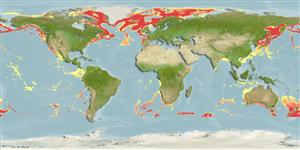
biển tầng đáy biển sâu; mức độ sâu 92 - 2925 m (Ref. 119696), usually 300 - 2300 m (Ref. 9261). Deep-water; -1°C - 4°C (Ref. 119696); 82°N - 50°S, 180°W - 180°E
Arctic, Indian, Pacific and Atlantic oceans: in cold and deep waters.
Chiều dài lúc trưởng thành đầu tiên / Bộ gần gũi / Khối lượng (Trọng lượng) / Tuổi
Chín muồi sinh dục: Lm ?, range 94 - ? cm
Max length : 112 cm TL con đực/không giới tính; (Ref. 114953); 100.0 cm TL (female)
Mô tả ngắn gọn
Khóa để định loại | Hình thái học | Sinh trắc học
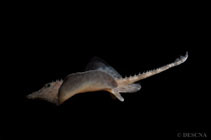
Grey-brown with large dark blotches (Ref. 26346). Tail very short (Ref. 26346). Mid-dorsal row of stout thorns which extend from nuchal region to first dorsal fin. Thorns close posterior to the pelvic girdle larger than along the tail (Ref. 6902). Upper surface dark mouse gray, dark blue gray or dark brown with small rounded spots. Lower surface white and sooty in variable patterns (Ref. 6902).
Body shape (shape guide): other.
Found on the lower continental slope (Ref. 6871), probably most common on deep slopes and at abyssal depths (Ref. 114953). Benthic (Ref. 58426); meso- to bathybenthic, on muddy substrate (Ref. 119696). Adults feed on all kinds of bottom animals (Ref. 3167). Prefer polar temperatures from hatching to maturity and eggs are incubated successfully and regularly in water as cold as 0°C (Ref. 6902). Oviparous. Distinct pairing with embrace. Young may tend to follow large objects, such as their mother (Ref. 205). Eggs are oblong capsules with stiff pointed horns at the corners deposited in sandy or muddy flats (Ref. 205). Egg capsule measures 81-125 mm long and 50-80 mm wide (Ref. 41251). Hatching size at 16-18 cm TL (Ref. 114953) (15 cm long in Ref. 119696).
Oviparous, paired eggs are laid. Embryos feed solely on yolk (Ref. 50449). Distinct pairing with embrace. Young may tend to follow large objects, such as their mother (Ref. 205).
McEachran, J.D. and K.A. Dunn, 1998. Phylogenetic analysis of skates, a morphologically conservative clade of elasmobranchs (Chondrichthyes: Rajidae). Copeia 1998(2):271-290. (Ref. 27314)
Tình trạng Sách đỏ IUCN (Ref. 130435: Version 2025-2 (Global))
Mối đe dọa đối với con người
Harmless
Sử dụng của con người
Các nghề cá: không ích lợi (thú vị)
Các công cụ
Báo cáo đặc biệt
Tải xuống XML
Các nguồn internet
Ước tính dựa trên mô hình
Nhiệt độ ưa thích (Tài liệu tham khảo
123201): 0.3 - 8.8, mean 3.3 °C (based on 3242 cells).
Chỉ số đa dạng phát sinh loài (Tài liệu tham khảo
82804): PD
50 = 0.5039 [Uniqueness, from 0.5 = low to 2.0 = high].
Bayesian length-weight: a=0.00302 (0.00141 - 0.00645), b=3.24 (3.07 - 3.41), in cm total length, based on LWR estimates for this (Sub)family-body shape (Ref.
93245).
Mức dinh dưỡng (Tài liệu tham khảo
69278): 4.3 ±0.5 se; based on diet studies.
Thích nghi nhanh (Tài liệu tham khảo
120179): thấp, thời gian nhân đôi của chủng quần tối thiểu là 4.5 - 14 năm (Fec assumed to be <100).
Sự dễ bị tổn thương của nghề đánh cá (Ref.
59153): High to very high vulnerability (67 of 100).
🛈
Sự dễ bị tổn thương của khí hậu (Ref.
125649): Moderate vulnerability (38 of 100).
🛈
Chất dinh dưỡng (Ref.
124155): Calcium = 3.31 [0.50, 67.94] mg/100g; Iron = 0.302 [0.029, 4.121] mg/100g; Protein = 15.3 [13.3, 17.3] %; Omega3 = 0.494 [0.199, 1.207] g/100g; Selenium = 20.6 [3.6, 97.8] μg/100g; VitaminA = 6.37 [0.45, 85.10] μg/100g; Zinc = 0.206 [0.013, 2.410] mg/100g (wet weight);