Ελασμοβράγχιοι (καρχαρίες και σαλάχια) (sharks and rays) >
Rajiformes (Skates and rays) >
Rajidae (Skates)
Etymology: Amblyraja: Greek, amblys = darkness + Latin, raja, -ae = ray (Raja sp.) (Ref. 45335).
Περιβάλλον: περιβάλλον / κλιματική ζώνη / εύρος βάθους / εύρος διανομής
Οικολογία
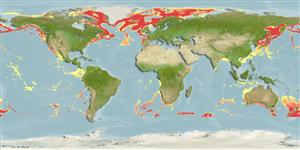
Θαλασσινό(ά) βαθύβιο(ς); εύρος βάθους 92 - 2925 m (Ref. 119696), usually 300 - 2300 m (Ref. 9261). Deep-water; -1°C - 4°C (Ref. 119696); 82°N - 50°S, 180°W - 180°E
Arctic, Indian, Pacific and Atlantic oceans: in cold and deep waters.
Μήκος κατά την πρώτη ωρίμανση / Μέγεθος / Βάρος / Ηλικία
Γεννητική Ωρίμανση: Lm ?, range 94 - ? cm
Max length : 112 cm TL αρσενικό/απροσδιόριστο; (Ref. 114953); 100.0 cm TL (female)
Σύντομη περιγραφή
Κλείδες προσδιορισμού | Μορφολογία | Μορφομετρία
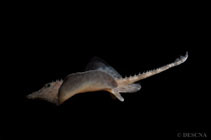
Grey-brown with large dark blotches (Ref. 26346). Tail very short (Ref. 26346). Mid-dorsal row of stout thorns which extend from nuchal region to first dorsal fin. Thorns close posterior to the pelvic girdle larger than along the tail (Ref. 6902). Upper surface dark mouse gray, dark blue gray or dark brown with small rounded spots. Lower surface white and sooty in variable patterns (Ref. 6902).
Body shape (shape guide): other.
Found on the lower continental slope (Ref. 6871), probably most common on deep slopes and at abyssal depths (Ref. 114953). Benthic (Ref. 58426); meso- to bathybenthic, on muddy substrate (Ref. 119696). Adults feed on all kinds of bottom animals (Ref. 3167). Prefer polar temperatures from hatching to maturity and eggs are incubated successfully and regularly in water as cold as 0°C (Ref. 6902). Oviparous. Distinct pairing with embrace. Young may tend to follow large objects, such as their mother (Ref. 205). Eggs are oblong capsules with stiff pointed horns at the corners deposited in sandy or muddy flats (Ref. 205). Egg capsule measures 81-125 mm long and 50-80 mm wide (Ref. 41251). Hatching size at 16-18 cm TL (Ref. 114953) (15 cm long in Ref. 119696).
Κύκλος ζωής και συμπεριφορά ζευγαρώματος
Γεννητική Ωρίμανση | Αναπαραγωγή | Γεννοβολία | Αβγά | Γονιμότητα | Προνύμφες
Oviparous, paired eggs are laid. Embryos feed solely on yolk (Ref. 50449). Distinct pairing with embrace. Young may tend to follow large objects, such as their mother (Ref. 205).
McEachran, J.D. and K.A. Dunn, 1998. Phylogenetic analysis of skates, a morphologically conservative clade of elasmobranchs (Chondrichthyes: Rajidae). Copeia 1998(2):271-290. (Ref. 27314)
Κατάσταση Κόκκινου Καταλόγου IUCN (Ref. 130435: Version 2025-2 (Global))
Απειλή για τον άνθρωπο
Harmless
Ανθρώπινες χρήσεις
αλιεία: χωρίς ενδιαφέρον
Εργαλεία
Ειδικές εκθέσεις
Λήψη XML
Διαδικτυακές πηγές
Εκτιμήσεις βάσει μοντέλων
Προτιμώμενη θερμοκρασία (Αναφ.
123201): 0.3 - 8.8, mean 3.3 °C (based on 3242 cells).
Δείκτης φυλογενετικής ποικιλότητας (Αναφ.
82804): PD
50 = 0.5039 [Uniqueness, from 0.5 = low to 2.0 = high].
Bayesian length-weight: a=0.00302 (0.00141 - 0.00645), b=3.24 (3.07 - 3.41), in cm total length, based on LWR estimates for this (Sub)family-body shape (Ref.
93245).
Τροφικό Επίπεδο (Αναφ.
69278): 4.3 ±0.5 se; based on diet studies.
Ελαστικότητα (Αναφ.
120179): Χαμηλό, ελάχιστος χρόνος για διπλασιασμό πληθυσμού 4,5 - 14 έτη (Fec assumed to be <100).
Ευπάθεια στην αλιεία (Ref.
59153): High to very high vulnerability (67 of 100).
🛈
Ευπάθεια στο κλίμα (Ref.
125649): Moderate vulnerability (38 of 100).
🛈
Θρεπτικά συστατικά (Ref.
124155): Calcium = 3.31 [0.50, 67.94] mg/100g; Iron = 0.302 [0.029, 4.121] mg/100g; Protein = 15.3 [13.3, 17.3] %; Omega3 = 0.494 [0.199, 1.207] g/100g; Selenium = 20.6 [3.6, 97.8] μg/100g; VitaminA = 6.37 [0.45, 85.10] μg/100g; Zinc = 0.206 [0.013, 2.410] mg/100g (wet weight);