Elasmobranquios (tiburones y rayas) (sharks and rays) >
Carcharhiniformes (Ground sharks) >
Sphyrnidae (Hammerhead, bonnethead, or scoophead sharks)
Etymology: Sphyrna: Probable misspelling of sphyra (Gr.), hammer, referring to their hammer-shaped heads (See ETYFish); tiburo: From tiburon, Spanish for shark, a name given by 16th- and 17th-century navigators to one or more large species of shark (See ETYFish).
More on author: Linnaeus.
Taxonomic Remarks
Sphyrna vespertina in the Eastern Pacific Ocean and Sphyrna alleni from Belize to Brazil, WA (Ref. 132488).
Entorno: milieu / zona climática / rango de profundidad / gama de distribución
Ecología
marino; salobre asociado a arrecife; oceano-estuarine (Ref. 87829); rango de profundidad 10 - 80 m (Ref. 244). Subtropical; 45°N - 36°S, 121°W - 32°W (Ref. 55302)
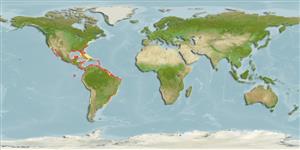
Western Atlantic: North Carolina, U.S to Belize. Species complex with Sphyrna vespertina in the Eastern Pacific Ocean and Sphyrna alleni from Belize to Brazil, WA (Ref. 132488).
Longitud en la primera madurez / Tamaño / Peso / Edad
Madurez: Lm 85.0, range 80 - 90 cm
Max length : 150 cm TL macho / no sexado; (Ref. 5217); common length : 80.0 cm TL macho / no sexado; (Ref. 5217); peso máximo publicado: 10.8 kg (Ref. 40637); edad máxima reportada: 12 años (Ref. 26248)
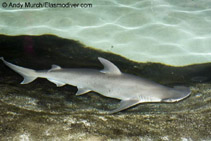
Front of head semicircular in outline. No other hammerhead has front of head in semicircle. (Ref. 26938).
Body shape (shape guide): elongated.
Found on the continental and insular shelves, on inshore and coastal areas, over mud and sand bottoms, also on coral reefs. Often occur in shallow water including estuaries, shallow bays and over coral reefs (Ref. 9987). Spends night time hours on shallow grass flats, searching for nocturnally active invertebrate prey, moves into deeper water during the day (Ref. 27549). Adults feed mainly on crustaceans, also on bivalves, octopi, and small fish. However, this is the first shark species to demonstrate omnivorous digestive strategy (Ref. 118574). It has been shown through digestability analyses that bonnetheads have enzymes that can digest seagrass organic matter with at least moderate efficiency (Ref. 118574). Viviparous, with 6 to 9 young per litter. Size at birth about 35 to 40 cm. Not territorial. Always occurs in small groups. Considerable sexual segregation occurs. Shows diel rhythm of activity. Utilized for human consumption and processed for fishmeal.
Viviparous, placental (Ref. 50449), with 6 to 9 young per litter. Size at birth about 35 to 40 cm.
Gonzalez, C., B. Postaire, W. Driggers, S. Caballero and D, Chapman, 2024. Sphyrna alleni sp. nov., a new hammerhead shark (Carcharhiniformes, Sphyrnidae) from the Caribbean and the Southwest Atlantic. Zootaxa 5512(4):491-511. (Ref. 132488)
Situación en la Lista Roja de la UICN (Ref. 130435: Version 2025-2 (Global))
Amenaza para el ser humano
Harmless
Usos humanos
Pesquerías: comercial; pesca deportiva: si
Herramientas
Informes especiales
Descargar XML
Fuentes de Internet
Estimaciones basadas en modelos
Temperatura preferida (Referencia
123201): 21.8 - 28, mean 25 °C (based on 368 cells).
Índice de diversidad filogenética (Referencia
82804): PD
50 = 0.5006 [Uniqueness, from 0.5 = low to 2.0 = high].
Bayesian length-weight: a=0.00204 (0.00116 - 0.00359), b=3.10 (2.94 - 3.26), in cm total length, based on LWR estimates for this species & (Sub)family-body (Ref.
93245).
Nivel trófico (Referencia
69278): 3.9 ±0.0 se; based on diet studies.
Resiliencia (Referencia
120179): Muy bajo, población duplicada en un tiempo mínimo superior a 14 años (K=0.17-0.34; tm=3; tmax=12; Fec=3).
Vulnerabilidad pesquera (Ref.
59153): High vulnerability (57 of 100).
🛈
Nutrientes (Ref.
124155): Calcium = 6.95 [1.35, 35.56] mg/100g; Iron = 0.372 [0.090, 1.111] mg/100g; Protein = 21.3 [19.1, 23.4] %; Omega3 = 0.115 [0.044, 0.282] g/100g; Selenium = 15.4 [4.2, 49.6] μg/100g; VitaminA = 16.5 [4.9, 59.7] μg/100g; Zinc = 0.52 [0.24, 1.15] mg/100g (wet weight);