Elasmobranchi (squali e razze) (sharks and rays) >
Carcharhiniformes (Ground sharks) >
Carcharhinidae (Requiem sharks)
Etymology: Rhizoprionodon: rhiza (Gr.), root; prion (Gr.) saw; odon (Gr.), tooth, referring to teeth with serrated (saw-like) bases, or roots [replacement name for Rhizoprion Ogilby 1915, preoccupied by Rhizoprion Jourdan 1861 in mammals] (See ETYFish); taylori: In honor of entomologist Frank Henry Taylor (1886-1945), Institute of Tropical Medicine, Townsville, North Queensland, Australia, who collected holotype (See ETYFish).
Eponymy: Frank Henry Taylor (1886–1945) was an entomologist at the Institute of Tropical Medicine, Townsville, Queensland, Australia. [...] (Ref. 128868), visit book page.
More on author: Ogilby.
Ambiente: milieu / zona climatica / distribuzione batimetrica / gamma di distribuzione
Ecologia
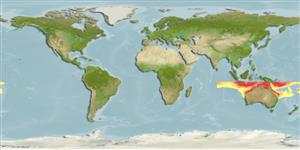
marino pelagic-oceanic; distribuzione batimetrica ? - 300 m (Ref. 75154). Tropical; 8°S - 28°S
Western Pacific: off Papua New Guinea and northern Australia.
Lunghezza alla prima maturità / Dimensione / Peso / Età
Maturità: Lm 47.0, range 42 - ? cm
Max length : 69.1 cm TL maschio/sesso non determinato; (Ref. 9161); Età massima riportata: 7 anni (Ref. 9161)
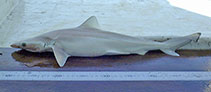
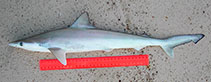
Spine dorsali (totale) : 0; Spine anali: 0. Brownish grey above, white below, fins light-edged but not conspicuously marked (Ref. 9997).
Body shape (shape guide): fusiform / normal.
A little-known shark (Ref. 9997) found on the continental shelf from close inshore to a depth of at least 110 m (Ref. 6871). Feeds mainly on fishes, but also takes cephalopods and crustaceans (Ref. 6871). Viviparous (Ref. 50449). Caught frequently by inshore demersal gillnet fisheries off Papua, but rarely elsewhere. Utilized for its fins and meat (Ref.58048). Too small to be of any commercial importance (Ref. 6871).
Ciclo vitale e comportamento di accoppiamento
Maturità | Riproduzione | Deposizione | Uova | Fecondità | Larve
Viviparous, with a yolk-sac placenta (Ref. 9997) and 1-10 pups after a gestation period of 11-12 months; born at ~ 25 cm TL; very rapid growth (Ref.58048). Distinct pairing with embrace (Ref. 205).
Compagno, L.J.V., 1984. FAO Species Catalogue. Vol. 4. Sharks of the world. An annotated and illustrated catalogue of shark species known to date. Part 2 - Carcharhiniformes. FAO Fish. Synop. 125(4/2):251-655. Rome: FAO. (Ref. 244)
Stato della Lista Rossa IUCN (Ref. 130435: Version 2025-2 (Global))
Minaccia per l'uomo
Harmless
Usi umani
Pesca: bycatch
Strumenti
Rapporti speciali
Scarica XML
Fonti Internet
Stime basate su modelli
Temperatura preferita (Fonte Biblio.
123201): 22.5 - 28, mean 26.6 °C (based on 321 cells).
Indice di diversità filogenetica (Fonte Biblio.
82804): PD
50 = 0.5078 [Uniqueness, from 0.5 = low to 2.0 = high].
Bayesian length-weight: a=0.00427 (0.00200 - 0.00910), b=3.10 (2.93 - 3.27), in cm total length, based on LWR estimates for this Genus-body shape (Ref.
93245).
Livello trofico (Fonte Biblio.
69278): 4.5 ±0.0 se; based on diet studies.
Generation time: 2.6 ( na - na) years. Estimated as median ln(3)/K based on 2
growth studies.
Resilienza (Fonte Biblio.
120179): Molto basso, tempo minimo di raddoppiamento della popolazione più di 14 anni (K=1.01-1.34; tm=1; tmax=7; Fec=1-8).
Vulnerabilità della pesca (Ref.
59153): Low to moderate vulnerability (33 of 100).
🛈