Elasmobranquios (tiburones y rayas) (sharks and rays) >
Carcharhiniformes (Ground sharks) >
Carcharhinidae (Requiem sharks)
Etymology: Rhizoprionodon: rhiza (Gr.), root; prion (Gr.) saw; odon (Gr.), tooth, referring to teeth with serrated (saw-like) bases, or roots [replacement name for Rhizoprion Ogilby 1915, preoccupied by Rhizoprion Jourdan 1861 in mammals] (See ETYFish); lalandii: In honor of naturalist and explorer Pierre Antoine Delalande (1787-1823), who collected type [authorship often attributed to Müller & Henle, who published Valenciennes’ description] (See ETYFish).
Eponymy: Pierre Antoine Delalande (1787–1823) was a French naturalist and explorer who worked for Muséum National d’Histoire Naturelle, Paris. [...] (Ref. 128868), visit book page.
Entorno: milieu / zona climática / rango de profundidad / gama de distribución
Ecología
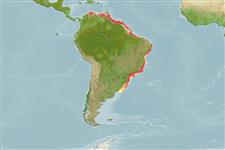
marino demersal; rango de profundidad 3 - 70 m (Ref. 244). Tropical; 13°N - 35°S, 78°W - 31°W
Western Atlantic: Panama to southern Brazil and Uruguay (Ref. 58839).
Longitud en la primera madurez / Tamaño / Peso / Edad
Madurez: Lm 61.8, range 58 - ? cm
Deprecated: number_format(): Passing null to parameter #1 ($num) of type float is deprecated in /var/www/html/includes/common.lib.php on line 1833
Max length : 80.0 cm TL (female); common length : 55.0 cm TL macho / no sexado; (Ref. 5217); peso máximo publicado: 0.00 g
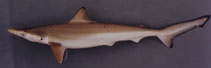
Inhabits shallow coastal waters, on sandy and muddy bottoms, and not normally found in lagoons and estuaries (Ref. 244). Feeds on small bony fishes, including sardines and anchovies, also shrimp and squid (Ref. 244). Viviparous, with 1 to 4 young in a litter; size at birth 33 to 34 cm (Ref. 244). Its flesh is highly appreciated and is marketed dried salted.
Distinct pairing with embrace (Ref. 205). Viviparous, placental (Ref. 50449).
Compagno, L.J.V., 1999. Checklist of living elasmobranchs. p. 471-498. In W.C. Hamlett (ed.) Sharks, skates, and rays: the biology of elasmobranch fishes. Johns Hopkins University Press, Maryland. (Ref. 35766)
Situación en la Lista Roja de la UICN (Ref. 130435: Version 2025-2 (Global))
Amenaza para el ser humano
Harmless
Usos humanos
Pesquerías: comercial
Herramientas
Informes especiales
Descargar XML
Fuentes de Internet
Estimaciones basadas en modelos
Temperatura preferida (Referencia
123201): 24.6 - 28, mean 27.2 °C (based on 104 cells).
Índice de diversidad filogenética (Referencia
82804): PD
50 = 0.5078 [Uniqueness, from 0.5 = low to 2.0 = high].
Bayesian length-weight: a=0.00275 (0.00180 - 0.00421), b=3.07 (2.95 - 3.19), in cm total length, based on LWR estimates for this species & Genus-body shape (Ref.
93245).
Nivel trófico (Referencia
69278): 4.3 ±0.65 se; based on food items.
Resiliencia (Referencia
120179): Muy bajo, población duplicada en un tiempo mínimo superior a 14 años (Fec=1).
Vulnerabilidad pesquera (Ref.
59153): Moderate to high vulnerability (52 of 100).
🛈