Elasmobranchii (haaien en roggen) (sharks and rays) >
Carcharhiniformes (Ground sharks) >
Carcharhinidae (Requiem sharks)
Etymology: Rhizoprionodon: rhiza (Gr.), root; prion (Gr.) saw; odon (Gr.), tooth, referring to teeth with serrated (saw-like) bases, or roots [replacement name for Rhizoprion Ogilby 1915, preoccupied by Rhizoprion Jourdan 1861 in mammals] (See ETYFish); lalandii: In honor of naturalist and explorer Pierre Antoine Delalande (1787-1823), who collected type [authorship often attributed to Müller & Henle, who published Valenciennes’ description] (See ETYFish).
Eponymy: Pierre Antoine Delalande (1787–1823) was a French naturalist and explorer who worked for Muséum National d’Histoire Naturelle, Paris. [...] (Ref. 128868), visit book page.
Milieu: milieu / Klimaatzone / Diepte / verspreidingsgebied
Ecologie
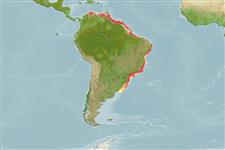
marien demersaal; diepte 3 - 70 m (Ref. 244). Tropical; 13°N - 35°S, 78°W - 31°W
Western Atlantic: Panama to southern Brazil and Uruguay (Ref. 58839).
Lengte bij maturiteit / Grootte / Gewicht / Leeftijd
Maturiteit: Lm 61.8, range 58 - ? cm
Deprecated: number_format(): Passing null to parameter #1 ($num) of type float is deprecated in /var/www/html/includes/common.lib.php on line 1833
Max length : 80.0 cm TL (female); common length : 55.0 cm TL mannelijk / geslacht onbekend; (Ref. 5217); max. gepubliceerd gewicht: 0.00 g
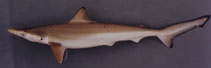
Inhabits shallow coastal waters, on sandy and muddy bottoms, and not normally found in lagoons and estuaries (Ref. 244). Feeds on small bony fishes, including sardines and anchovies, also shrimp and squid (Ref. 244). Viviparous, with 1 to 4 young in a litter; size at birth 33 to 34 cm (Ref. 244). Its flesh is highly appreciated and is marketed dried salted.
Distinct pairing with embrace (Ref. 205). Viviparous, placental (Ref. 50449).
Compagno, L.J.V., 1999. Checklist of living elasmobranchs. p. 471-498. In W.C. Hamlett (ed.) Sharks, skates, and rays: the biology of elasmobranch fishes. Johns Hopkins University Press, Maryland. (Ref. 35766)
Status op de Rode Lijst van het IUCN (Ref. 130435: Version 2025-2 (Global))
Gevaar voor de mens
Harmless
Gebruik door de mens
Visserij: commercieel
Tools
Speciale rapporten
Download XML
Internetbronnen
Schattingen op basis van modellen
Gewenste temperatuur (Ref.
123201): 24.6 - 28, mean 27.2 °C (based on 104 cells).
Fylogenetische diversiteitsindex (Ref.
82804): PD
50 = 0.5078 [Uniqueness, from 0.5 = low to 2.0 = high].
Bayesian length-weight: a=0.00275 (0.00180 - 0.00421), b=3.07 (2.95 - 3.19), in cm total length, based on LWR estimates for this species & Genus-body shape (Ref.
93245).
Trofisch niveau (Ref.
69278): 4.3 ±0.65 se; based on food items.
Weerstandsvermogen (Ref.
120179): Zeer laag, minimale populatieverdubbelingstijd meer dan 14 jaar (Fec=1).
Kwetsbaarheid van de visserij (Ref.
59153): Moderate to high vulnerability (52 of 100).
🛈