Taxonomic Remarks
This species was not reported since the 19th century in the Mediterranean Sea. An award will be granted by the CIESM to any documented, reliable / verifiable evidence (published paper / Ph.D thesis / photo) reporting the species after that date (Ref. 116564).
Окружающая среда: среда / климатическая зона / пределы глубины / диапазон распространения
экология
морской; пресноводный; солоноватоводный демерсальный; мигрирует в океане (Ref. 51243); пределы глубины 25 - ? m (Ref. 114953). Subtropical; 35°N - 40°S, 120°W - 160°E (Ref. 114953)
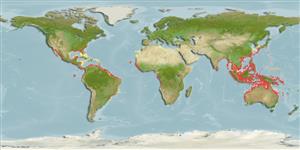
Circumglobally in tropical and subtropical waters, entering estuaries and littoral lagoons and ascending river courses (Ref. 81284, 81624). Western Atlantic: Florida and Louisiana, USA to Brazil (Ref. 7251); eastern Atlantic: Portugal to Angola, including the western Mediterranean Sea (Ref. 4429; no report since the 19th century [Ref. 116564] ); western Pacific: northern Australia, from western Australia to Queensland (Ref. 7300); eastern Pacific: Gulf of California to Ecuador (Ref. 4429). In freshwater it can be found in rivers of West Africa (Ref. 81284), Ogowe River (Ref. 81284) and the Congo River estuary (Ref. 377, 81284).
Длина при первой зрелости / Размер / Вес / Возраст
половая зрелость: Lm 300.0, range 300 - 300 cm
Max length : 750 cm TL самец/пол неопределен; (Ref. 57708); common length : 250 cm TL самец/пол неопределен; (Ref. 4429); наибольший возраст (опубликованны данные): 30 годы (Ref. 57533)
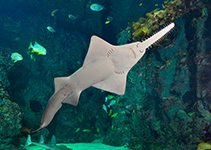
Diagnosis: Rostral blade with 20 or fewer pairs of rostral spines (Ref. 81624).
Body shape (shape guide): elongated.
A euryhaline species (Ref. 57533). Inhabits inshore coastal waters to moderate depth, also around off lying islands. Found also in estuaries, lagoons, river mouths, and even freshwater. Feeds on fishes and bottom-living animals. Ovoviviparous. Apparently can reproduce in freshwater (Ref. 57533). Freshwater populations occur to about 750 km up Amazon River; populations in Lake Nicaragua may be non-migratory (Ref. 7251). Reaches sexual maturity at 8-10 years and females have litters of approximately 1-13 pups. Young spend much of their early life in rivers up to 400 km from the sea (Ref. 114953).
Жизненный цикл и брачное поведение
половая зрелость | размножение | нерест | икра | Плодовитость | личинки
Ovoviviparous, embryos feed solely on yolk (Ref. 50449).
Stehmann, M., 1990. Pristidae. p. 51-54. In J.C. Quero, J.C. Hureau, C. Karrer, A. Post and L. Saldanha (eds.) Check-list of the fishes of the eastern tropical Atlantic (CLOFETA). JNICT, Lisbon; SEI, Paris; and UNESCO, Paris. Vol. 1. (Ref. 4429)
Статус Красного Списка МСОП (Ref. 130435: Version 2025-2 (Global))
Угроза для людей
Harmless
Использование человеком
рыболовство: не имеет хозяйственного значения
дополнительная информация
инструменты
Специальные отчеты
Скачать в формате XML
ресурсы в Интернет
Оценки, основанные на моделях
Предпочтительная температура (ссылка
123201): 20.1 - 29.1, mean 27.8 °C (based on 1796 cells).
Индекс филогенетического разнообразия (ссылка
82804): PD
50 = 0.5234 [Uniqueness, from 0.5 = low to 2.0 = high].
Bayesian length-weight: a=0.00501 (0.00199 - 0.01264), b=3.05 (2.82 - 3.28), in cm total length, based on LWR estimates for this (Sub)family-body shape (Ref.
93245).
Трофический уровень (ссылка
69278): 4.0 ±0.60 se; based on food items.
устойчивость к внешним воздействиям (ссылка
120179): низкий, минимальное время удвоения популяции 4.5-14 лет (tmax=44; Fec=1-20;).
Уязвимость рыбной ловли (Ref.
59153): Very high vulnerability (79 of 100).
🛈
Питательные вещества (Ref.
124155): Calcium = 8.73 [1.69, 40.68] mg/100g; Iron = 0.523 [0.130, 1.505] mg/100g; Protein = 20.3 [18.1, 22.3] %; Omega3 = 0.173 [0.070, 0.432] g/100g; Selenium = 37 [10, 113] μg/100g; VitaminA = 2.11 [0.72, 6.06] μg/100g; Zinc = 0.367 [0.179, 0.703] mg/100g (wet weight);